

Crypto has been a rough ride lately. Stocks are ripping, commodities are rallying, and even collectible markets are on fire—everything except crypto. If you’ve been in the space long enough, you know market cycles are brutal, but the last six months felt uniquely messy. Below I break down the ten biggest reasons crypto has underperformed recently, why each one matters, and what to watch next. This isn’t hand-wringing—this is a practical map for surviving and finding opportunity when others give up.
Table of Contents
- Quick overview: What went wrong
- 1. The 10/10 liquidation crash — structural liquidity damage
- 2. Digital asset treasury companies — a fast money stampede
- 3. The Trump connection — politics and extractive tokens
- 4. Wall Street takeover — ownership and incentives changed
- 5. Quantum computing FUD — legitimate tech fear
- 6. Taxes and reporting — the IRS is coming
- 7. The meme coin casino — extractive and predatory schemes
- 8. Too many coins and fragmented liquidity
- 9. Lack of deep, meaningful innovation (beyond narratives)
- 10. Competition from AI, robotics, and macro markets
- What this all adds up to
- How to think about positioning now
- Which of these problems are getting better (and which will take time)
- Red flags I still watch closely
- Where opportunity lives right now
- Final thoughts
- Is crypto dead?
- What should I do about taxes?
- Are memecoins worth trading?
- How can I protect myself from liquidity shocks?
- Should I use trade signals?
- Closing
Quick overview: What went wrong
There isn’t a single villain here. The downturn is the result of overlapping structural, behavioral, political, and technological pressures. Those forces combined created a market that was fragile, extractive, and frankly less fun to trade. But many of these are healable wounds. Some are already getting better. Others will take time. Below I unpack each cause and highlight what it means for traders and investors.
1. The 10/10 liquidation crash — structural liquidity damage
The most immediate and devastating event was the October 10 liquidation cascade. Over $19 billion in leveraged positions were wiped out and roughly 1.6 million traders were affected. That wasn’t just trader pain—it destroyed a ton of the market’s liquidity providers and market makers.
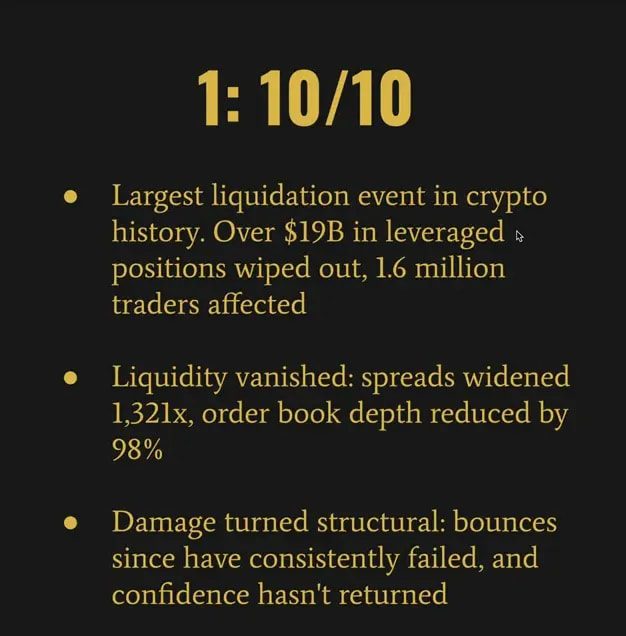
Spreads widened by over 1,300x and order book depth fell by roughly 98% in some venues. When market makers get hurt this badly they don’t come back overnight. That structural damage turned routine volatility into existential flash-crashes. Since 10/10 any bounce has struggled because confidence evaporated. The lesson: liquidity is market infrastructure. When it breaks, everything else becomes risky.
2. Digital asset treasury companies — a fast money stampede
Earlier last year we saw a wave of public companies converting portions of their treasuries into crypto. At first, that drove significant demand and pushed prices higher from July to October. But it got frothy fast.
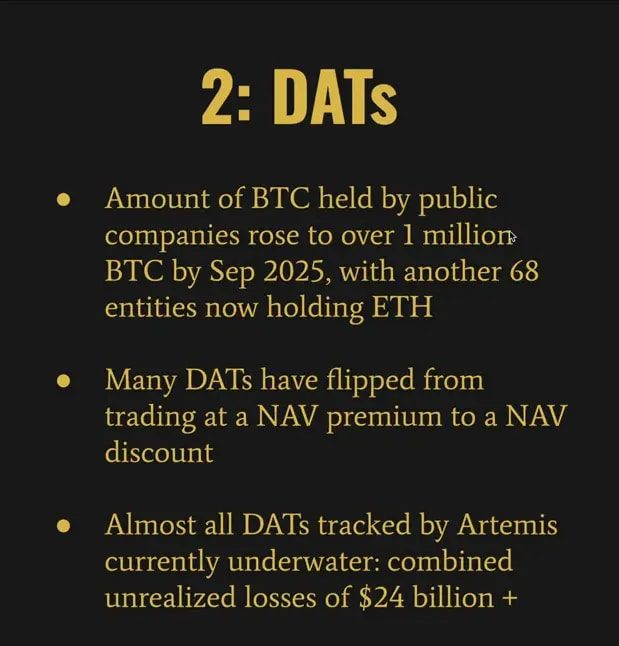
These setups looked like quick arbitrage for shareholders: flip to crypto, ride the pump, announce the treasury change, insiders sell. The initial entrants made serious money, the second wave made some, and by wave three the returns started evaporating. Many of these tickers moved from trading at a premium to trading at a discount to NAV as capital flowed out.
Omid Malek and other analysts called this an aggregate extraction event—and they were right. In the aggregate, these corporate treasury plays pumped demand and then accelerated exits when sentiment turned. That helped explain the mid-cycle pop and subsequent vulnerability when that demand dried up.
3. The Trump connection — politics and extractive tokens
Politics became a real price factor. A large chunk of corporate political donations in 2024 came from the crypto sector. That created a linkage between crypto and a specific political brand. The fallout was twofold:
- Highly extractive token launches—examples like Trump token and Melania token—ripped capital out of the market and left massive losses for retail.
- Industry reputation suffered as extractive projects and insider cashouts dominated headlines.
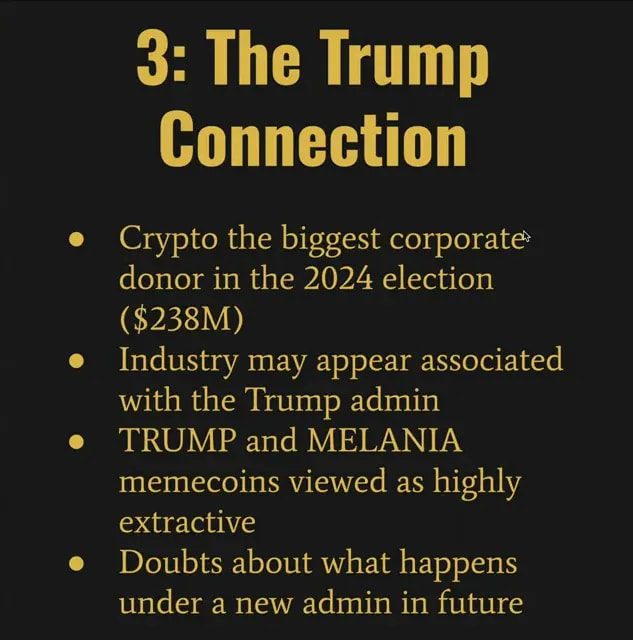
Those tokens made quick profits for insiders and catastrophic losses for many wallets. Even though legislation like the Genius Act or a potential Clarity Act might be positive long-term, the immediate market impact was reputational damage and capital flight from risky experiments.
4. Wall Street takeover — ownership and incentives changed
Wall Street moved in and changed the composition of holders. ETFs and institutions now control a meaningful share of Bitcoin supply—estimates put institutional ownership around 12% for bitcoin-related instruments. When big players step in they bring capital and legitimacy, but they also bring different incentives.
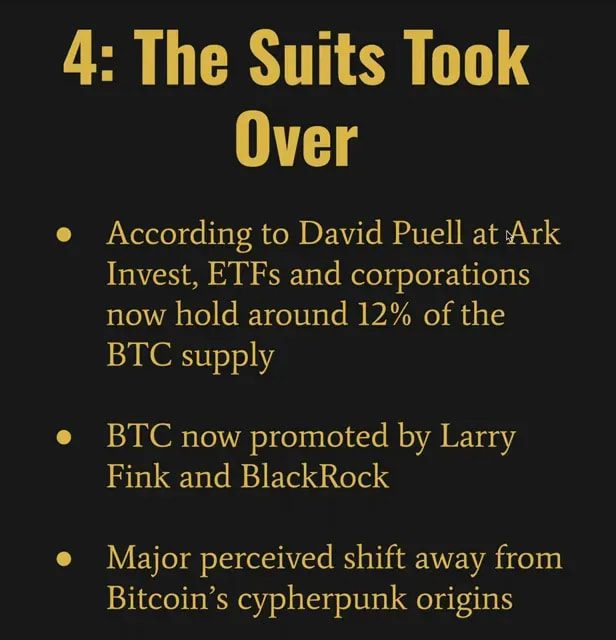
Traditional investors focus on returns and risk-adjusted allocation, not cypherpunk ideals. That shift changes price behavior. Institutions tend to buy the perceived safe core: Bitcoin, Ethereum, maybe Solana and XRP. They do not chase the meme coin casino. That means the market bifurcated—core assets saw steady institutional flows while the rest of the market lost the new money that once amplified pumps.
5. Quantum computing FUD — legitimate tech fear
Quantum computing sparked a wave of fear that got traction on social media. The argument: quantum breakthroughs could break the cryptographic primitives that secure wallets and transactions. There are over 6 million BTC in addresses with exposed public keys that could theoretically be targeted.
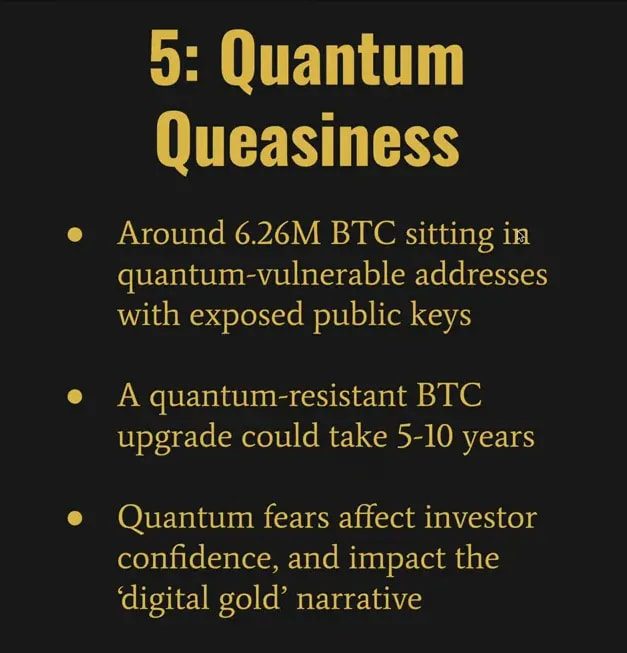
Solutions exist—Bitcoin devs have proposed research into quantum-resistant upgrades—but those changes could take 5 to 10 years to implement. Some analysts say we don’t have that long. Whether the timeline is urgent or not, the idea that your digital gold could be “broken” by quantum machines is enough to scare some capital out of the market, especially more conservative investors.
6. Taxes and reporting — the IRS is coming
Tax clarity is good in principle, but enforcement and reporting have made life harder for active traders. New reporting requirements mean US exchanges will report digital asset sales to the IRS, and you’ll receive a copy. This exposes sloppy bookkeeping and unreported taxable events.

Most traders misunderstand how taxes apply. Every crypto-to-crypto trade is a taxable event. The blockchain isn’t anonymous. If you want to survive a tax audit, you need proper cost-basis tracking for every transaction—staking, airdrops, NFTs, DeFi interactions—everything.
If you’ve been treating bookkeeping like a shrug, start treating it like risk management. Accurate records are not optional anymore. For active traders this is a real operational cost and a reason some casual participants stepped back.
7. The meme coin casino — extractive and predatory schemes
Meme coins exploded into the mainstream again, but this time with professional predators. Organized cartels and on-chain extraction schemes turned many memecoins into pump-and-dump machines. Insider fees and flash crashes destroyed trust.
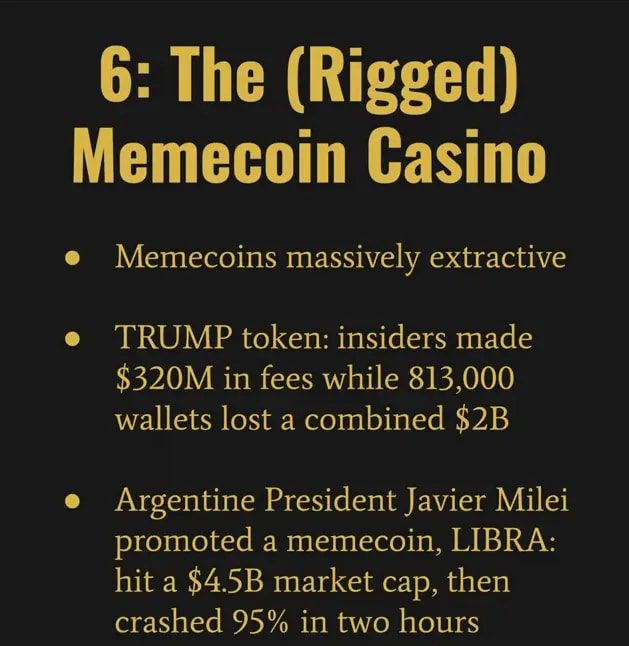
Some numbers are staggering: insiders making hundreds of millions, hundreds of thousands of wallets losing billions combined, and tokens that spiked to multi-billion valuations collapsing within hours. Solitus Labs claimed close to 99% of some pump pools were worthless. The memecoin market may remain vibrant culturally, but its extractive episodes are a drag on broader market sentiment.
8. Too many coins and fragmented liquidity
There are over 10,000 active coins, millions created and already dead. Back in 2017 there were about 1,000. Liquidity is fragmented across chains, exchanges, and token pairs. That makes price action more brittle. When the pool of new capital shrinks—because of scams, crashes, or macro shifts—the “hot potato” of money moves slower and fewer coins pump.
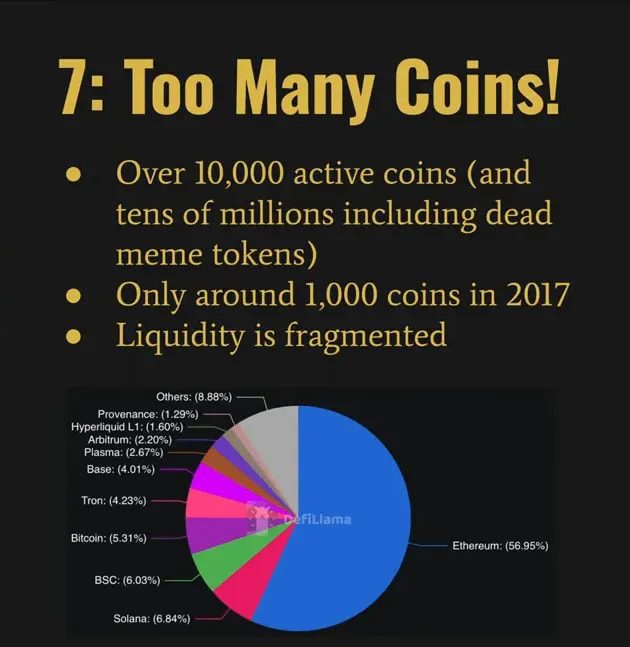
My practical rule: there may be roughly a hundred investable coins in the whole market that have durable liquidity, real teams, and credible use cases. The rest are noise. When liquidity is fragmented and the hot money slows, the market looks flat and depressing even if pockets of real innovation exist.
9. Lack of deep, meaningful innovation (beyond narratives)
There have been interesting projects—HyperLiquid is a solid example, and prediction markets like Polymarket and Kalshi are fascinating financial infrastructure—but a lot of the loud innovation has been thin narratives or flashy tokenomics.
Meme coins, NFT refreshes, and marketing-driven “playbooks” helped pump prices but didn’t always deliver sustainable value. Real innovation—protocol-level improvements, genuine real-world asset tokenization, composable DeFi primitives—exists but it hasn’t yet produced a broad enough growth engine to offset the damage from scams and extractive models.
10. Competition from AI, robotics, and macro markets
Crypto is now competing for capital with some of the most exciting sectors in the market: AI, semiconductors, robotics, infrastructure, and energy. That competition matters. Capital flows into where it finds the best risk-adjusted returns and the most tangible innovation.
Nvidia alone at times has been worth nearly twice the entire crypto market cap. When AI stocks and related hardware rally, they pull allocation away from crypto—especially speculative altcoins. Crypto’s better use cases are financial in nature: DeFi, tokenization, and rails for digital markets. Investors who want to capture secular tech growth have other choices, and that reallocation pressure shows up as persistent underperformance for many crypto assets.
What this all adds up to
Layer these ten items and you get a market that is wounded, more institutionalized, and less forgiving of sloppy projects. The narrative damage—extractive memecoins, politics, and scams—has decreased the pool of marginal buyers. Structural problems—liquidity damage and fragmented markets—made the price action more brutal. Genuine technological concerns like quantum FUD add an extra layer of fear.
But this is not the same as “it’s over.” Markets heal. Liquidity providers rebuild balance sheets. Quality projects keep shipping. And when pessimism peaks, opportunities appear. High pessimism tends to equal high optionality for those who are careful and thoughtful.
How to think about positioning now
Here’s a pragmatic playbook for navigating the current environment.
- Respect liquidity risk — avoid heavy leverage and exchange-only custody. The 10/10 event taught us how fast positions can vaporize when markets flash-crash.
- Concentrate on the investable cohort — focus on the handful of assets with real liquidity, working teams, and long-term roadmaps instead of chasing every narrative token.
- Use risk management tools — position sizing, stop-loss discipline, and diversified exposures matter more now than ever.
- Stay tax-compliant — track cost basis and record every trade; regulatory reporting is real and costly mistakes are common.
- Watch for structural repair — order book depth, market maker re-entry, and tighter spreads are signs the market is healthy again.
For active traders who want an edge in this choppy market, disciplined trade signals that focus on high-probability setups can help you avoid noise and concentrate on assets and timeframes with positive risk/reward. Crypto spot trading signals—when used with proper risk management—can guide entry and exit timing across Bitcoin, Ethereum, Solana and other liquid chains. The key is to pair signals with your own capital-sizing rules and due diligence, not to hand over decision-making entirely.
Which of these problems are getting better (and which will take time)
Some wounds start to heal faster than others:
- Recovering: Post-10/10 liquidity repair is underway. Market makers are returning slowly and spreads have narrowed from their worst levels.
- Mixed: Institutional ownership is sticky—this is a long-term structural shift that changes how markets behave, not necessarily how they perform.
- Slow to fix: Quantum risk and meaningful protocol-level upgrades will take coordinated developer effort and time.
- Behavioral: Trust lost to memecoin scams and extractive tokens will take time and better on-chain governance to rebuild.
Red flags I still watch closely
- Recurring large flash crashes that wipe market maker books again.
- Continuing wave after wave of extractive token launches with insider enrichments.
- Regulatory moves that materially restrict access or introduce punitive taxation measures without clarity.
- Failure of major infrastructure projects to deliver on promised upgrades (like quantum-resistant planning).
Where opportunity lives right now
Pessimism is often the mother of opportunity. When most people walk away the best traders pay attention. Look for:
- Quality projects trading at meaningful discounts to fundamentals or treasury value.
- Assets showing improving liquidity metrics—narrowing spreads, expanding order book depth, and increased market maker participation.
- Real adoption or product traction—DeFi protocols with real TVL growth, NFT marketplaces with persistent demand, or prediction markets being monetized.
If you’re actively trading the bounce or hunting value, combine careful market analysis with actionable trade ideas. Crypto spot trading signals can help you spot cross-chain opportunities, time entries into leading coins rather than noise tokens, and manage exits in a way that protects capital while capturing moves. Use signals as one input among many—plan your trade, size it conservatively, and stick to your risk rules.
Final thoughts
Ten distinct reasons explain why crypto has been painful lately: liquidity shocks, extractive corporate plays, political drama, Wall Street’s different incentives, quantum fear, tax enforcement, memecoin carnage, fragmenting liquidity, spotty innovation, and a shift of capital into AI and other tech sectors. Combined they made this cycle extra messy.
But the market is not dead. Many of these issues are repairable or temporary. The tech continues to advance, real products are shipping, and capital cycles shift. High pessimism means higher chances of finding asymmetric opportunities—if you stay disciplined and focus on quality. Remember: survival and optionality beat heroics in rough markets.
Is crypto dead?
No. Crypto is not dead. What we saw was a painful consolidation and structural reshuffling. Liquidity and confidence were hit hard, but quality projects, developer activity, and institutional interest remain. The timeframe for recovery is uncertain, but opportunities will re-emerge as the market repairs itself.
What should I do about taxes?
Start tracking everything now. Every crypto-to-crypto trade is a taxable event. Use reliable tax tools and reconcile your cost basis for all transactions. If you’ve been putting this off, catch up before the IRS reporting forms arrive.
Are memecoins worth trading?
Memecoins can produce huge short-term moves, but they’re extremely high risk and rife with extractive schemes. If you trade them, size positions tiny, have strict exit rules, and only use capital you can afford to lose. For most traders, focusing on liquid, credible assets is smarter.
How can I protect myself from liquidity shocks?
Avoid high leverage, diversify across custody and protocols, and prefer exchanges and venues with deep order books. Use position sizing and stop-losses, and consider keeping an allocation in stable, liquid core assets during market stress.
Should I use trade signals?
Signals can be a useful input if they are transparent about methodology and risk management. Use them to help time entries and exits across liquid coins, but pair them with your own research and strict sizing rules. Complement signals with awareness of macro, liquidity, and tax considerations.
Closing
Markets that feel broken create space for disciplined players. Right now, that means respecting the structural damage, avoiding extractive plays, staying tax-compliant, and hunting for quality at a discount. If you want to scavenge short-term opportunities across BTC, ETH, SOL and other liquid chains, use a measured signal-driven approach with conservative sizing to avoid the traps that wrecked so many wallets the past six months.
Keep your head. Focus on liquidity, fundamentals, and risk management. That’s how you navigate ugly markets and position yourself for the next leg up.