
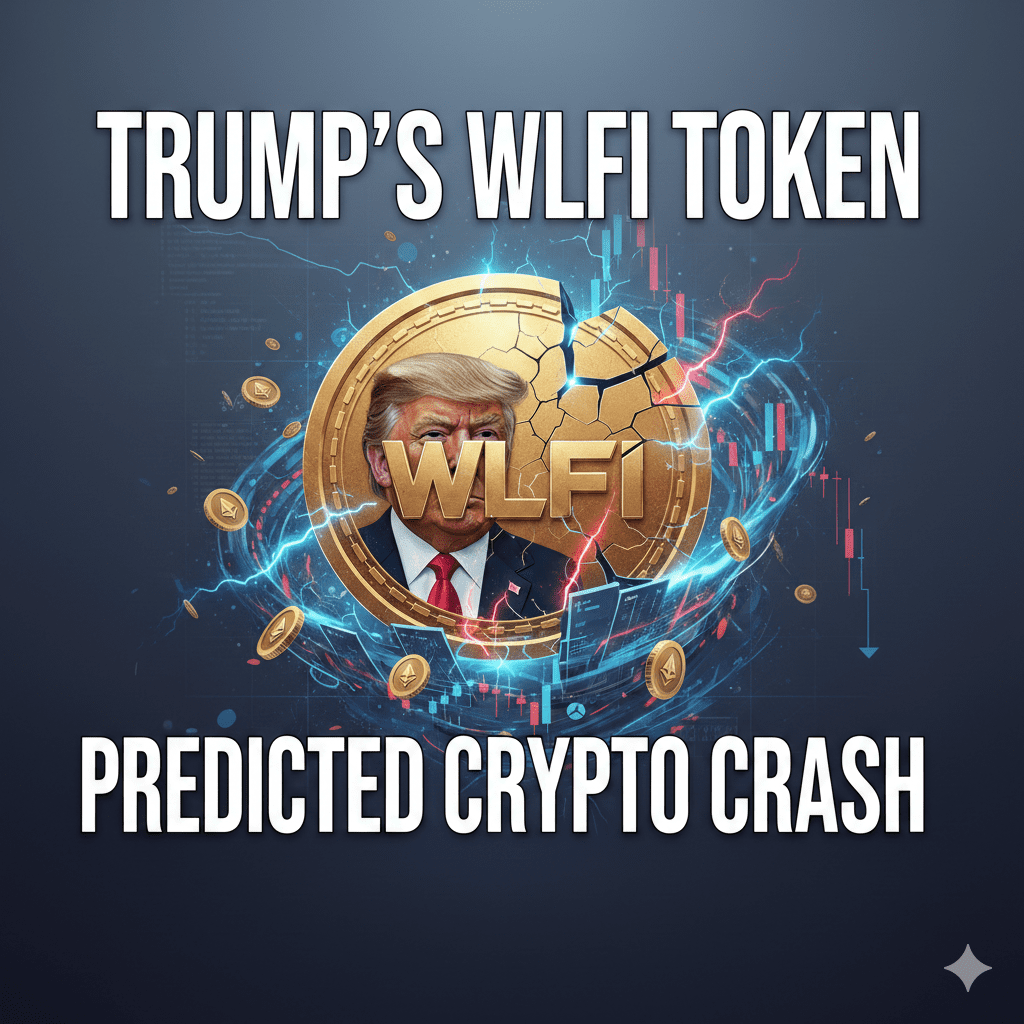
Table of Contents
- Overview: a tiny token, a huge market ripple
- What happened on October 10: the timeline that matters
- How WLFI signaled danger: the four early-warning metrics
- How a small token created a domino effect across the market
- Political tokens as information transmission mechanisms
- Could WLFI’s insiders have avoided insider-trading allegations while still profiting?
- Actionable checklist: metrics to monitor for early-warning signals
- How traders and analysts can put this into practice
- Case study: a hypothetical reconstruction of the cascade
- Portfolio rules and best practices after WLFI
- Signals in practice: integrating crypto signals into your workflow
- Dealing with political risk in crypto
- What WLFI teaches us about market structure
- Practical watchlist for the next political cycle
- Lessons for exchanges and risk managers
- Will political tokens keep being early warning signals?
- Final thoughts and a practical nudge
- FAQ
- Recommended next steps
Overview: a tiny token, a huge market ripple
On October 10 a concentrated sell-off in WLFI — the governance token tied to World Liberty Financial, a crypto project associated with the Trump family — preceded a catastrophic liquidation cascade that wiped roughly $6.93 billion from the market. At first glance WLFI looked like a small, headline-grabbing political token. When you unpack the data, however, WLFI acted like a canary in a coal mine: extreme funding rates, sudden volume spikes, pulverized order-book liquidity and a highly clustered ownership structure combined to create an early-warning signal that the rest of the market would follow.
This article breaks down what happened, why a low-market-cap token helped trigger a much broader crash, how these cascades work, and what traders and analysts should do next to avoid getting blindsided. Expect plain language explanations of funding rates, cross-margin mechanics, volatility beta, and a practical checklist you can use right now to monitor risky tokens — plus an integrated look at how “crypto signals” can help you identify and act on these early warning signs.
What happened on October 10: the timeline that matters
The order of events is crucial. A handful of timestamps tell the story of how a localized sell-off became a marketwide disaster.
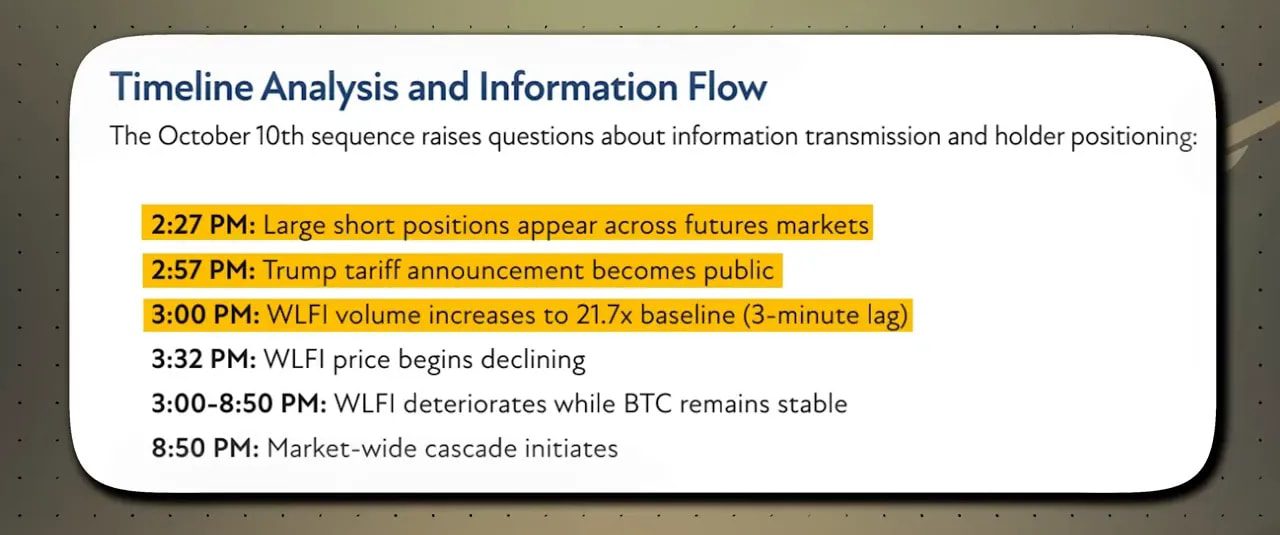
- 14:27 UTC — Large short positions appear in futures markets. This indicates some participants were already positioning for risk that same afternoon.
- 14:57 UTC — A Truth Social post from Donald J. Trump announces a plan to impose 100% tariffs on China. This public policy signal matters because WLFI holders include politically connected insiders.
- 15:00 UTC — Within three minutes of the announcement, WLFI hourly trading volume explodes from an average of roughly $22 million to more than $474 million — a 21.7x spike. In one hour more WLFI changed hands than in the previous 20 hours combined.
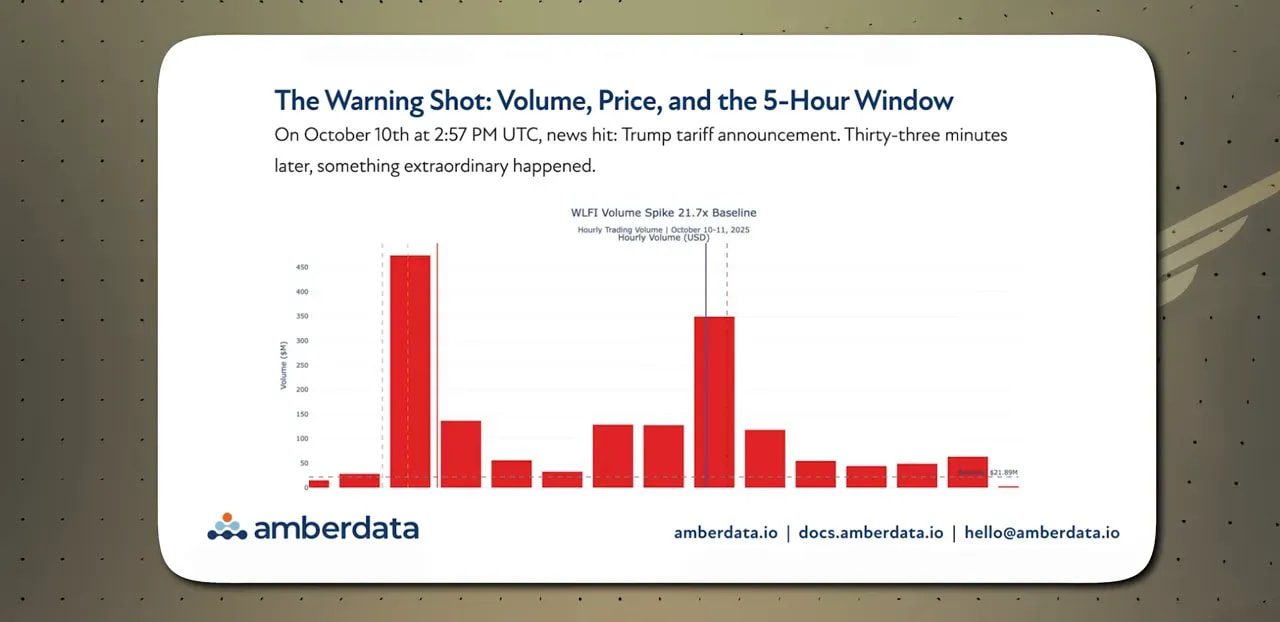
- 15:32 UTC — WLFI price begins to tank as insiders or large holders exit positions. Heavy liquidations in WLFI start at 15:32 UTC, more than five hours before major losses hit Bitcoin and the rest of the market.
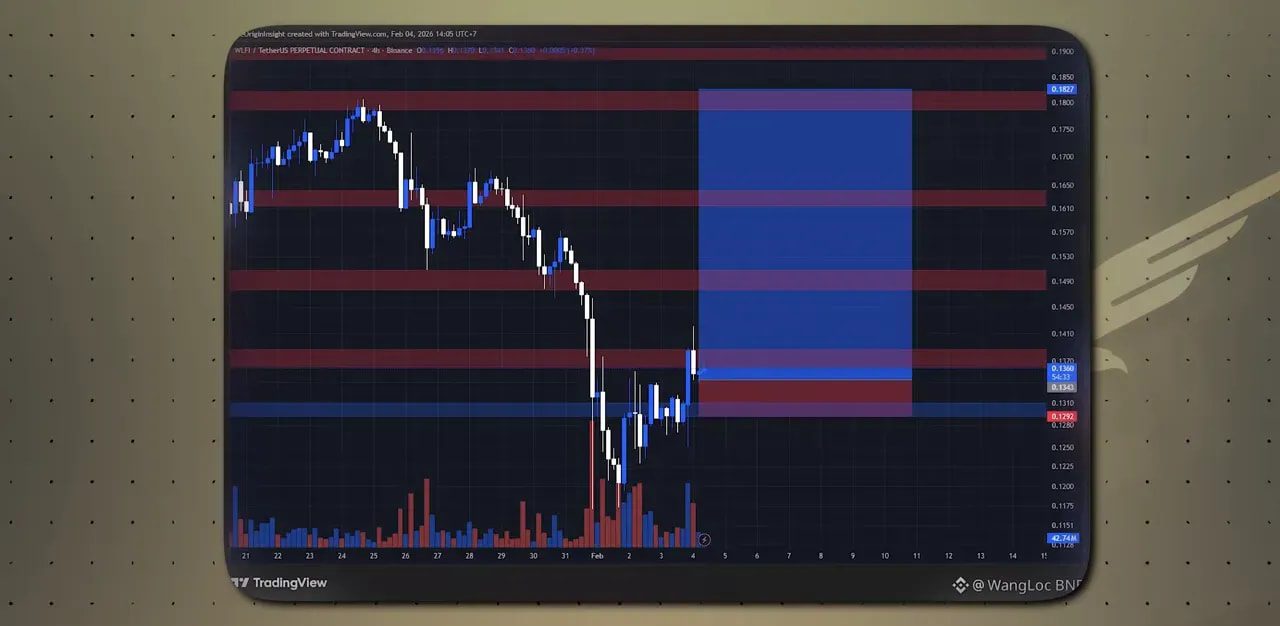
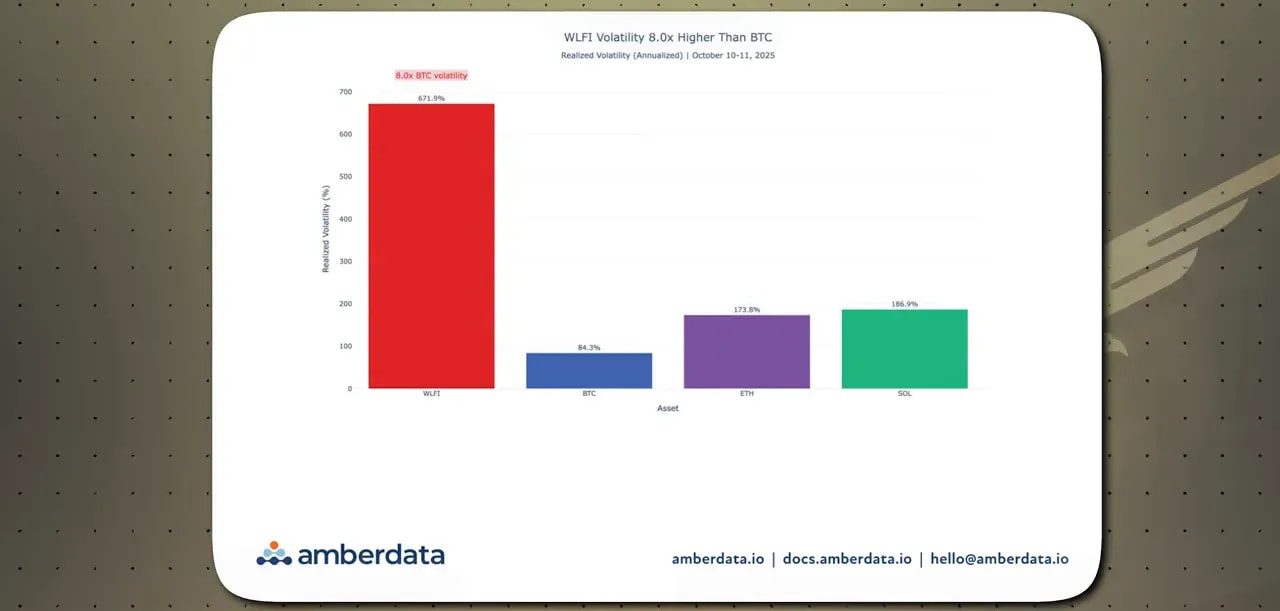
- 20:50 UTC — Bitcoin finally cracks. A forced selling cascade produces realized volatility of roughly 84% for BTC while WLFI’s realized volatility had already surged to about 671% — roughly eight times higher.
The crucial takeaway: WLFI’s distress preceded BTC’s collapse by five hours and 18 minutes. That gap is long enough for observant traders to reposition if they had access to the right metrics in real time.
How WLFI signaled danger: the four early-warning metrics
Amberdata’s analysis identified four metrics that together create a reliable early-warning system when they line up: extreme funding rates, explosive volume spikes, a dramatic volatility divergence relative to a market reserve asset, and evaporating order-book liquidity. Let’s unpack each.
1. Funding rate stress — a pressure cooker in perpetual futures
Funding rates are payments between longs and shorts in perpetual futures. When longs pay shorts, it means buyers of leverage are funding the trade; when shorts pay longs, sellers are paying. A persistently high positive funding rate reflects aggressive long-side leverage and a rising cost for longs to hold positions.
In the eight hours before the crash WLFI’s funding rate averaged about 2.8% versus Bitcoin’s 1%. Put another way, WLFI’s annualized borrowing cost exceeded ~131%. That is unsustainably high for retail or leveraged traders. High funding rates do two things simultaneously:
- They signal conviction — traders expect price appreciation enough to pay to hold the trade.
- They increase liquidation risk — the longer a high funding rate persists, the thinner the margin for error. A small adverse price move can trigger forced deleveraging at scale.
The practical implication: when you see a funding-rate divergence between an alt and BTC of 2x or 3x — especially for tokens with concentrated ownership — treat it as a red flag. Those positions are fragile.
2. Volume spikes that scream “insiders moved first”
WLFI’s hour-over-hour volume jump from ~$22 million to ~$474 million within three minutes of the tariff announcement is not retail behavior. Rapid, concentrated turnover on the order of 20x the baseline implies large holders executing pre-positioned exits. That timing is telling: insiders who knew the policy environment (or anticipated it) could get into position before the public announcement and then execute trades within the safe harbor of public disclosure.
Volume surges are especially meaningful when they coincide with tokens that have:
- concentrated ownership (a few addresses controlling a large share) and
- thin order-book depth (limited liquidity near market price).
When both conditions exist, a heavy seller can move price dramatically while simultaneously impacting leveraged traders who use that token as portfolio collateral.
3. Volatility divergence and the high-beta effect
WLFI’s realized volatility reached roughly 671% as the crash unfolded while Bitcoin’s sat at ~84%. High-beta assets move more, faster, and earlier when systemic stress appears. If a token’s volatility is multiple times that of BTC, it can act as a stress detector: small systemic shocks register as large moves in the high-beta asset.
Think of volatility beta this way: if WLFI’s volatility is 8x BTC’s, a 1% BTC move equates to an 8% WLFI move on average. That means WLFI was both an early mover and an amplifier. When WLFI plunged 55% and BTC later fell ~15%, that differential echoed the high-beta relationship and showed how smaller, more levered tokens can lead larger assets into trouble.
4. Liquidity evaporation — the market’s safety net disappears
Liquidity provision is painfully asymmetric: it looks ample during calm markets and collapses during stress. Amberdata measured order-book depth within 20 basis points of the mid-price, the practical liquidity that absorbs aggressive trades. During the WLFI event, WLFI’s depth within that band fell from about $1.8 million to just $10,000 — a 99% collapse. Bitcoin’s depth fell from $311 million to $11 million — a 96% reduction.
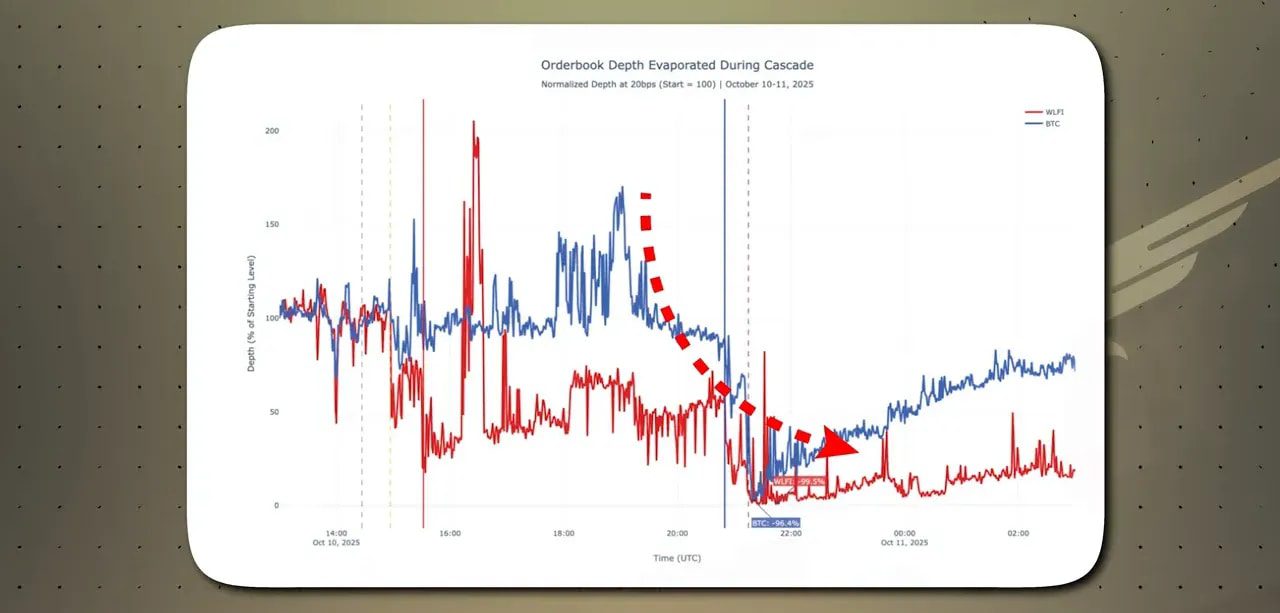
When liquidity evaporates, even modest market orders mechanically create outsized price moves, which trigger margin calls, forced liquidations and more selling. That positive feedback loop is the death spiral traders dread.
How a small token created a domino effect across the market
WLFI alone did not have the market capitalization to push Bitcoin directly. The mechanism that converted WLFI’s distress into a marketwide cascade is leverage interconnection — namely cross-margining and portfolio collateralization.
Here is the simplified chain:
- A large holder dumps WLFI, dropping its price 50% or more.
- Traders who hold WLFI as part of a cross-margined portfolio see their collateral value fall. Cross-margin means your whole account backs all your leveraged positions.
- Margin ratios fall below maintenance thresholds across other positions, initiating margin calls and automatic liquidations on more liquid assets such as BTC and ETH.
- These forced sales depress price in liquid markets, triggering additional margin events for other traders and exchanges.
- Order-book depth that would normally absorb large market orders has already withdrawn, so price moves are amplified.
Put simply, liquidity and leverage coupled with concentrated holdings create systemic fragility. The weakest link — WLFI in this case — provides the earliest signal of stress, but once the cascade begins, it no longer matters which token started it; the whole system becomes vulnerable.
Political tokens as information transmission mechanisms
Tokens backed by political actors or affiliated groups create a unique risk surface. Ownership is often clustered among insiders who move in the same circles, have quick lines of communication and can react within minutes to political signals. That asymmetry creates two structural problems:
- Information clustering: holders share privileged context about policy, regulatory changes and political strategy that most market participants do not.
- Concentration risk: a small set of wallets can control supply and execute large trades that overwhelm thin markets.
When you combine those characteristics with high leverage and thin liquidity, political tokens behave like pressure valves: they move first and hard when policy fundamentals change or when insiders choose to act. That makes them a potential early-warning signal — and also a hazard for retail participants who are not on the same information loop.
“In interconnected leverage systems, the weakest structural link provides the earliest signal of systematic stress.”
Could WLFI’s insiders have avoided insider-trading allegations while still profiting?
The timeline suggests plausible behavior that sits in a legal gray area: individuals with political proximity can pre-position themselves in expectation of a public announcement and then execute trades only after the message is public. Doing so minimizes direct insider trading risk because the execution occurs post-announcement, but the advantage still comes from having privileged access to the political process and anticipating its timing.
From a risk-management perspective, this is less about legal proof and more about recognizing pattern behavior. Large, abrupt volume spikes in politically connected tokens immediately after a public policy signal should raise alarms. Whether regulators will pursue action depends on the jurisdiction, the clarity of the evidence and enforcement priorities, but traders do not need a prosecution to be harmed by the market effects.
Actionable checklist: metrics to monitor for early-warning signals
You can reduce surprise events by watching a short set of high-signal metrics. If more than one lights up, treat it as a warning flag and consider defensive actions.
- Funding rate divergence: check for alt funding rates > 2x BTC or sharply rising funding rates over hours.
- Volume spike factor: hourly volume > 5x baseline, especially when paired with price moves.
- Volatility ratio: alt realized volatility / BTC realized volatility > 3x is a red flag; > 5x demands immediate attention.
- Order-book depth collapse: within 20 basis points of mid — if depth drops by >50% in minutes, liquidity has left the market.
- Ownership concentration: top 10 wallets holding > 30% supply increases liquidation risk when they sell.
- Political or regulatory news: sudden announcements or leaks that are directly relevant to token holders.
When two or more of the above criteria coincide, reduce leverage exposure, tighten stops or temporarily de-risk the portfolio until metrics stabilize.
How traders and analysts can put this into practice
Monitoring a handful of tokens manually is doable, but true edge comes from automation and timely alerts. This is where a disciplined signals service can be helpful. High-quality crypto signals do more than recommend trades; they monitor the market structure — funding rates, order-book depth, volume anomalies and volatility divergences — and deliver alerts when a combination of indicators crosses a predefined risk threshold.
Use cases for a signals service:
- Receive an alert when a funding-rate divergence between an alt and BTC exceeds a threshold.
- Get notified of abnormal hourly volume surges on politically linked or low-cap tokens.
- Track liquidity depth changes across multiple exchanges in near real time.
- Access curated watchlists that classify tokens by concentration risk and political exposure.
For traders who want to be proactive rather than reactive, a well-calibrated “crypto signals” product can mean the difference between repositioning before a crash and being liquidated by one.
Case study: a hypothetical reconstruction of the cascade
Let’s walk through an illustrative example to make the mechanics concrete. Numbers are simplified but capture the dynamic.
- Trader Alpha holds a cross-margined portfolio: 20% WLFI, 40% BTC, 40% ETH. With leverage, Alpha’s total notional exposure is 5x.
- WLFI falls 50% after a heavy sell. Alpha’s portfolio value falls by 10% from WLFI alone (20% weight x 50% fall).
- That 10% reduction pushes Alpha below maintenance margin for leveraged BTC and ETH positions. Exchange auto-liquidates BTC and ETH to meet margin.
- Forced sales depress BTC and ETH prices; other cross-margined traders suffer margin erosion and liquidations, leading to more forced selling.
- Order-book depth has already withdrawn across assets, so each liquidation causes outsized price moves, snowballing into the multi-billion-dollar wipeout.
The precise mechanics vary by margin rules, exchange, and concentration, but the qualitative sequence remains the same: a small, levered catalyst can precipitate a large market event when leverage and liquidity are interconnected.
Portfolio rules and best practices after WLFI
The October event should reset risk expectations for many traders. Here are practical rules to adopt:
- Limit cross-asset collateral exposure: avoid large allocations of illiquid or politically sensitive tokens in cross-margined accounts.
- Cap leverage by asset class: smaller-cap, higher-beta tokens should have drastically lower leverage limits than BTC or ETH.
- Set dynamic stop-losses: stops based on volatility-adjusted bands rather than fixed percentages can reduce false triggers and improve survivability.
- Use portfolio stress tests: model sudden 30-50% moves in small holdings to see if your portfolio survives the ripple effects.
- Maintain a liquidity buffer: keep enough capital in highly liquid assets to meet unforeseen margin calls without forced sales of illiquid positions.
Signals in practice: integrating crypto signals into your workflow
Integrating a signals service should be tactical and measured. Don’t treat signals as trade orders you must follow blindly; treat them as high-quality inputs for decision-making. The most effective implementation is a three-step workflow:
- Alert triage: review the alert context — what metrics triggered it and which tokens are involved?
- Quick counterfactuals: ask whether your portfolio includes the impacted token(s) or cross-margined positions that could be affected indirectly.
- Action plan: if exposure exists, take defensive steps — reduce leverage, increase cash, tighten stops, or hedge with inverse products.
A well-built crypto signals product will make each of these steps faster: alerts should include metric details, suggested action tiers and historical precedent so you can act quickly and confidently.
Dealing with political risk in crypto
Political tokens introduce a non-market dimension of risk: policy and reputation. That makes them appealing for quick speculative gains, but also uniquely dangerous. Consider the following when dealing with politically-affiliated tokens:
- Due diligence on ownership: track top addresses, token distribution and vesting schedules.
- Watch public schedules: political calendars, press cycles and known events can coincide with coordinated trading windows.
- Assess regulatory traction: tokens tied to political actors may invite faster regulatory scrutiny if market-distorting actions are suspected.
- Stay skeptical: if insiders benefit from a token’s structure or public narrative, price action may reflect personal incentives rather than fundamental product adoption.
As a blunt risk rule: if a token’s primary value driver is political narrative rather than protocol utility, position size should be tiny and time horizon short.
What WLFI teaches us about market structure
Several broader lessons emerge from WLFI’s role in October’s liquidation cascade:
- Leverage amplifies cross-asset fragility: cross-margin systems make isolated shocks systemic.
- Liquidity is fleeting: depth can vanish precisely when you need it most, turning manageable losses into market failures.
- Small caps can punch above their weight: extreme funding, concentration and volatility make them canaries — and catalysts.
- Information asymmetry matters: political proximity and insider coordination create market-moving advantages that aren’t visible to public on-chain activity alone.
These structural observations are not theoretical. They should influence how institutional desks, retail traders and regulators think about systemic risk in crypto markets.
Practical watchlist for the next political cycle
If political headlines are likely to increase, maintain a short watchlist and check it whenever a major policy announcement is imminent. Include:
- Tokens with explicit political branding or sponsorship
- Tokens with top-10 holder concentration > 25 to 30%
- Tokens with funding rates consistently > 2x BTC
- Tokens with average hourly liquidity < $5 million within 0.2% of price
- Tokens that historically show > 3x realized volatility vs BTC
If a token on your list starts to flash multiple metrics simultaneously, run an immediate risk assessment. If you hold exposure, reduce it quickly; if you don’t, add it to a surveillance queue.
Lessons for exchanges and risk managers
This event is a wake-up call for exchange risk teams. Simple changes can materially reduce systemic vulnerability:
- Limit cross-margin exposure for accounts holding small-cap, high-beta tokens.
- Implement dynamic margin requirements tied to funding-rate stress and volatility spikes.
- Provide better liquidity screens that trigger risk-management throttles when depth drops precipitously.
- Offer analytics to users that highlight concentration risk and political exposure for tokens they hold.
Risk management is expensive until it saves you from a wipeout. Exchanges that bake these protections into product design will be more resilient and attract risk-conscious participants.
Will political tokens keep being early warning signals?
Yes — as long as political tokens remain highly levered, thinly traded and concentrated among insiders, they will continue to be potential early detectors of systemic stress. The exact token that leads the next crash might be different, but the structural behavior will likely repeat: insiders move quickly, liquidity withdraws, margin cascades accelerate, and the market pays the price.
That means monitoring political tokens is not optional if you care about managing tail risk.
Final thoughts and a practical nudge
WLFI’s role in the October liquidation event is an uncomfortable reminder that markets are not purely mechanical — they are social systems influenced by information access, incentives and concentration. The smallest element of that system can act like a circuit breaker, and when circuits fail they fail fast.
If you want a pragmatic way to stay ahead of these dynamics, incorporate real-time monitoring tools into your workflow. A mature crypto signals service can surface the funding-rate divergences, volume anomalies and liquidity drains that matter. Use signals as an early-warning input, not a substitute for judgment. When several indicators align, act decisively: reduce leverage, increase liquidity and reassess counterparty and exchange risk exposure.
Above all, never assume that a low market cap equals low systemic importance. In a heavily levered, cross-margined world, the tiniest crack can become a full-blown rupture.
FAQ
Was WLFI solely responsible for the $6.93 billion crash?
No. WLFI was the catalyst in this instance, but the crash resulted from systemic conditions: high leverage, cross-margin structures, evaporating liquidity and interconnected positions across exchanges. WLFI’s sell-off triggered a chain reaction in that environment.
Could this be prosecuted as insider trading?
Prosecution depends on jurisdiction and the ability to prove individuals traded on non-public material information. The chronological pattern is suspicious, but legal outcomes require evidence beyond timing — communications, intent and clear private information misuse. Regulators may investigate, but market participants should respond regardless of whether legal action occurs.
What signals should I prioritize to detect similar events?
Prioritize funding-rate divergences, sudden volume surges relative to baseline, rapid increases in realized volatility versus benchmark assets, and intra-hour order-book depth collapses. When two or more coincide, treat it as a high-probability early warning.
How can I protect my portfolio from these cascades?
Reduce or eliminate cross-margined exposure to concentrated tokens, cap leverage on high-beta assets, maintain a liquidity buffer in top-tier assets, use volatility-aware stops and run stress tests that model sharp moves in small holdings.
Are political tokens inherently bad investments?
Not inherently, but they carry unique risks: ownership concentration, information asymmetry and reputation-driven value. If you trade them, keep position sizes small, horizons short and rely on robust risk controls.
How can a crypto signals service help me?
A high-quality signals service monitors the market structure metrics that matter — funding rates, liquidity depth, volume anomalies and volatility — and pushes timely alerts when dangerous combinations appear. Signals make detecting early-warning windows faster so you can act before a cascade widens.
Should exchanges change how they handle small, political tokens?
Yes. Exchanges should consider dynamic margining, additional liquidity safeguards and limits on how much illiquid or politically risky tokens can be used as cross-collateral. These measures can materially reduce systemic contagion risk.
Recommended next steps
If market survival matters to you, adopt a disciplined monitoring system today. Start with a watchlist of political and low-cap tokens, automate funding-rate and liquidity alerts, and run basic stress tests on your cross-margined accounts. Consider augmenting your toolkit with a trusted crypto signals service that provides real-time alerts for the exact metrics discussed above. Signals are not a magic bullet, but used wisely they are a practical component of a modern risk-management stack.
The market will throw surprises. You can choose whether those surprises wipe you out or alert you just in time to move to safety.