
Table of Contents
- Overview
- Why agentic AI needs crypto
- Concrete use cases where AI + crypto unlock new capabilities
- Where decentralized infrastructure fills the gap
- Data quality, poisoning risks, and how crypto can help
- Privacy, secure inference, and zero-knowledge proofs
- Risks and failure modes to watch
- Regulation, compliance, and the role of proofs
- Which assets and layers are most likely to benefit?
- How traders and allocators should think about opportunity
- Edge cases: quantum resistance and long-term safety
- Practical checklist for builders and investors
- Where to expect speculative hype—and how to survive it
- Conclusion: Infrastructure wins, hype fades
- How exactly will AI agents use stablecoins?
- Final thought
Overview
2026 looks set to be the year where three narratives collide: stablecoins, tokenization, and artificial intelligence. Each one is powerful on its own, but together they form a potent infrastructure stack for autonomous agents, new financial rails, and entirely automated markets. This piece breaks down why that convergence matters, where real value is likely to accumulate, and what investors and builders should watch for as centralized AI costs and constraints push workloads toward decentralized alternatives.
Why agentic AI needs crypto
Agentic AI—software that can act autonomously to complete tasks—has already proven its value in finance. High-frequency trading firms, for example, use agentic systems to analyze streams of data and act in milliseconds. But those systems live inside legacy finance, which is built around humans and legal entities. That creates friction for autonomous software.
Agentic AI needs:
- Programmable money for autonomous payments and settlements.
- Tradable digital assets that can be transacted 24/7 without brokers or market hours.
- Instant, global settlement so agents can execute strategies across borders.
- Scalable compute and storage to train and run models.
- Trust-minimized infrastructure that reduces single points of failure and enables verifiability.
Cryptocurrency ecosystems already provide these building blocks through smart contracts, tokenized assets, stablecoins, decentralized compute and storage networks, and cryptographic proofs. In short, crypto is the natural home for autonomous financial agents that need to operate without human gatekeepers.
Concrete use cases where AI + crypto unlock new capabilities
1. Autonomous trading and portfolio managers
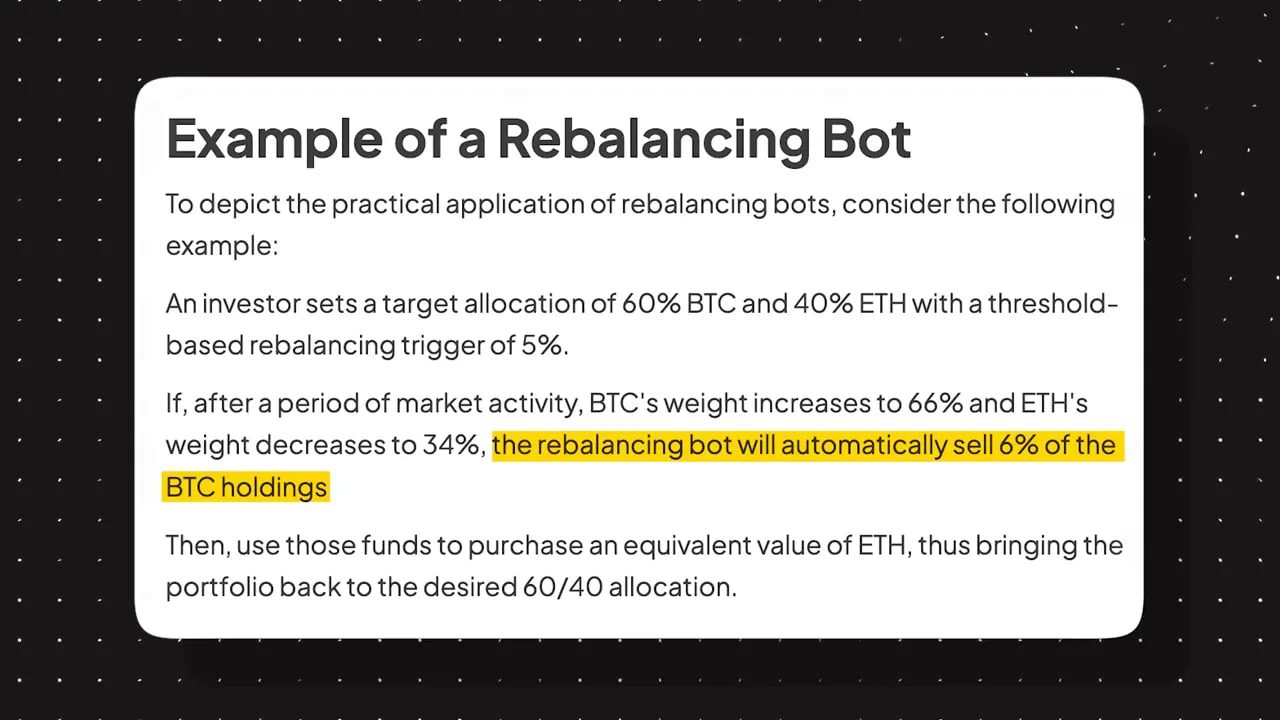
AI agents can design, backtest, and execute trading strategies continuously. Unlike humans, they don’t panic-sell during a correction or miss trades while asleep. They can also rebalance portfolios in real time: set a target allocation and let the agent enforce it as markets move. That matters for retail and institutional investors alike—automation scales strategy execution beyond periodic, manual rebalances.
2. Micropayments between AI agents
Micropayment protocols such as Coinbase’s x402 introduce the ability for agents to transact with tiny amounts of value, enabling a machine-to-machine economy. Agents can buy data, pay for compute cycles, subscribe to signals, or compensate other agents for services instantly and programmatically. This opens new business models that simply did not exist when cash and bank rails dominated payments.
3. Tokenized real-world assets (RWA)
AI can streamline the on-chain trading of tokenized stocks, treasuries, commodities, or real estate. By ingesting real-time market feeds and verification data, agents can automate compliance checks, liquidity management, and asset verification. The result is lower costs, faster settlement, and the possibility of 24/7 markets for assets that were traditionally constrained by exchanges and brokers.
4. DAO treasuries and autonomous businesses
Some projects are already testing AI agents to manage project treasuries, enforce policies, or operate DAO-like revenue-generating units. Agents can enforce rules transparently and perform repetitive governance tasks, helping organizations scale decision-making without bloated overhead.
Where decentralized infrastructure fills the gap
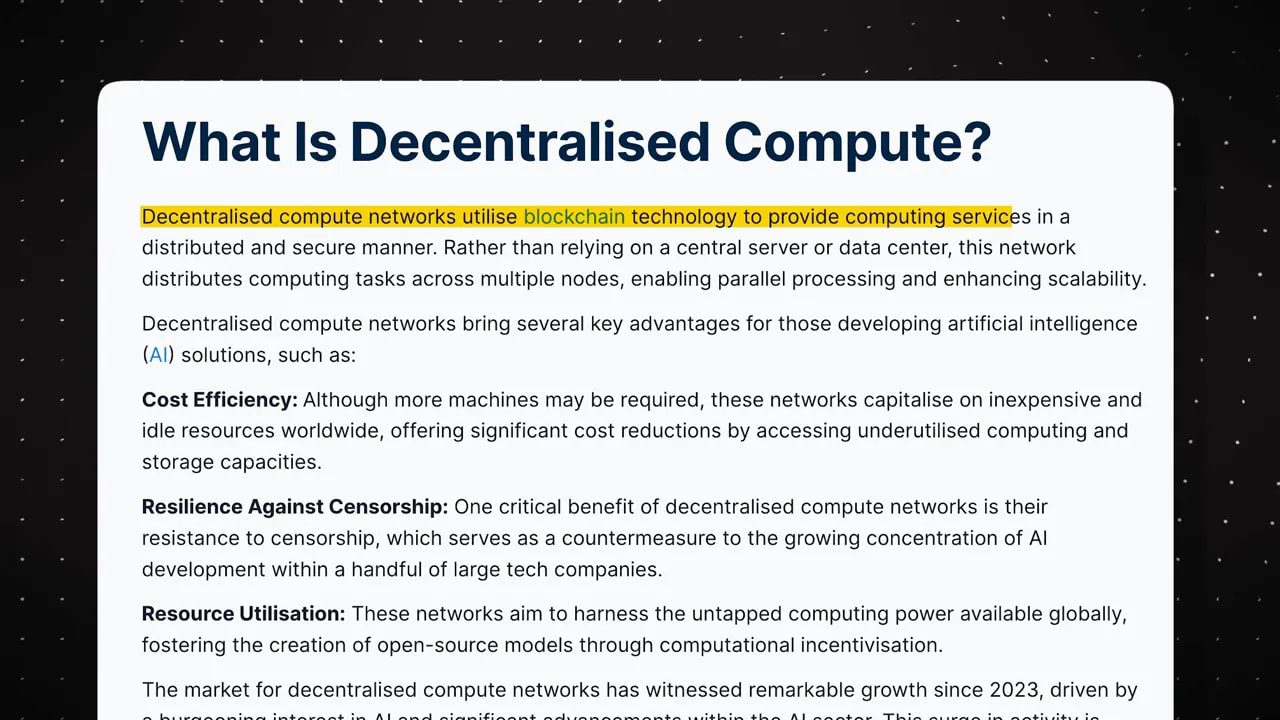
Centralized cloud providers currently shoulder most AI workloads. That creates several issues: rising costs, single points of failure, jurisdictional restrictions, and data routing bottlenecks. Decentralized physical infrastructure networks—DePINs—aim to tackle these problems by aggregating distributed compute and storage resources across many nodes.
Key advantages of decentralized compute and storage for AI:
- Cost efficiency through utilization of idle GPUs and competitive pricing.
- Scalability by pooling resources across many providers and locations.
- Verifiability so anyone can prove that compute tasks were executed as claimed, and on which model.
- Incentive alignment via tokens that reward contributors for compute, data, or governance participation.
Most crypto-AI projects today focus on inference—delivering model outputs—because inference is far easier to distribute than training. Large-scale training still demands enormous coordinated resources, but decentralized networks are closing the gap over time.
Data quality, poisoning risks, and how crypto can help
AI is only as good as the data it trains on. Centralized models have long relied on web scraping and opaque data pipelines, which invites bias, poor-quality examples, and even deliberate poisoning. Disturbingly, it doesn’t take much to corrupt a model: research suggests that a few hundred malicious documents can backdoor a model regardless of its size.
Decentralized systems introduce alternative mechanisms:
- Crowdsourced data contribution where contributors are compensated fairly, encouraging higher-quality submissions and broader representation.
- On-chain provenance that records who contributed what and when, making it possible to audit datasets and flag suspicious inputs.
- Community curation techniques that allow distributed participants to vet, rate, and remove low-quality or malicious data entries.
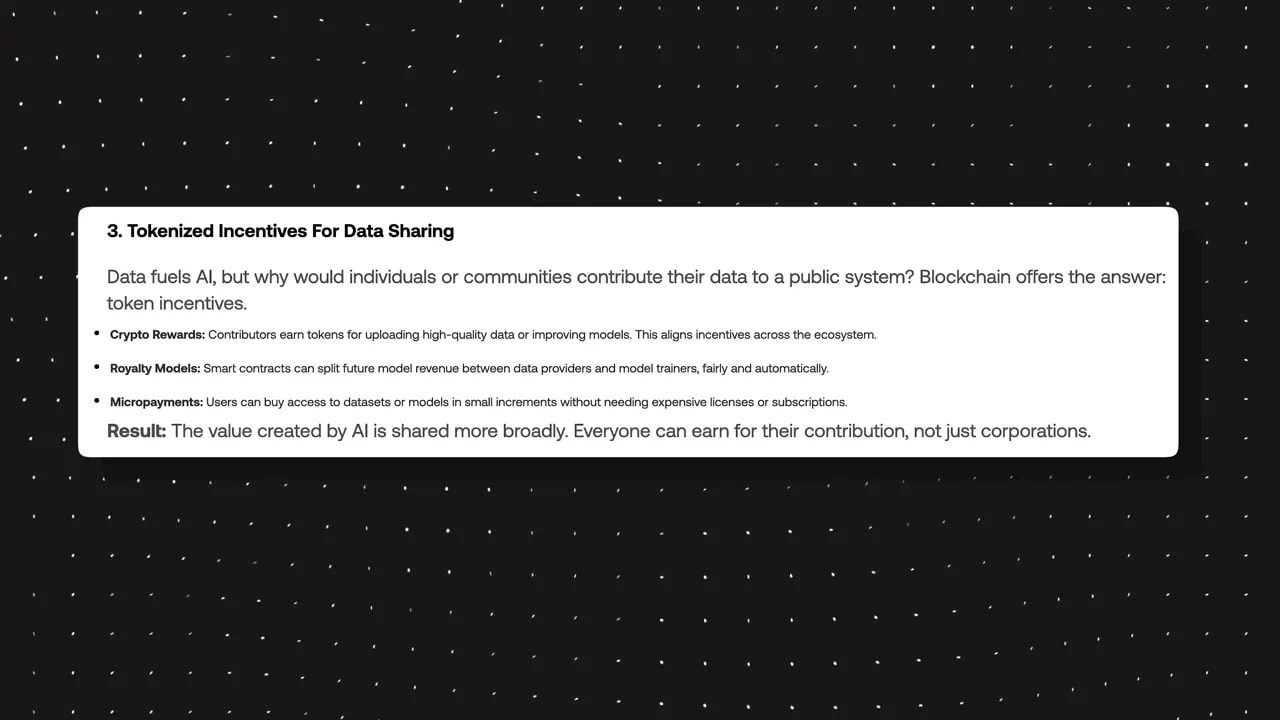
These approaches do not eliminate risk entirely, but they create economic incentives and transparency that make poisoning and unchecked bias harder and more expensive to perform at scale.
Privacy, secure inference, and zero-knowledge proofs
Privacy is a core concern when models process sensitive healthcare, financial, or enterprise data. Crypto-native privacy tools provide useful capabilities:
- Zero-knowledge proofs allow a party to prove a statement about data without revealing the data itself—useful for proving compliance or eligibility without exposing personal information.
- Confidential computing encloses model execution in secure enclaves so the input and output remain protected.
- Secure inference enables models to run on encrypted inputs and return verifiable results.
Combining these techniques makes it possible for AI models to be trained and used in regulated industries while still respecting privacy rules and compliance obligations.
Risks and failure modes to watch
The convergence of AI and crypto creates enormous potential, but the risks are real and sometimes systemic.
Hallucinations and incorrect decisions
AI agents can confidently act on incorrect information. In finance, that might mean repeatedly buying into a token that has already been drained by a rug pull. Without careful guardrails, automation can amplify mistakes.
MEV and predictability
AI-driven strategies can be highly deterministic: a given signal leads to a specific trade. That predictability makes transactions vulnerable to miner/extractor value attacks where validators front-run, sandwich, or reorder trades for profit. Agents executing predictable logic are easy prey unless defenses such as transaction obfuscation or private mempools are used.
Private key custody and contract risk
Handing private keys to autonomous software is dangerous. Misconfiguration, credential leaks, or interaction with buggy bridges and DeFi contracts can cause irreversible losses. The safest path is careful key management, multi-party computation, and strict human oversight as a backstop.
Monoculture and market fragility
Wide adoption of similar AI models, trained on the same datasets, risks creating a monoculture where many actors behave similarly. That synchronization can amplify volatility—if everyone attempts to hedge or unwind at once, liquidity dries up quickly and prices crash or spike.
Regulation, compliance, and the role of proofs
Legal clarity matters. Many AI-crypto projects currently operate in gray areas around KYC, data privacy, and securities classifications. Cryptographic tools help here: zero-knowledge proofs can verify that participants meet regulatory requirements without disclosing sensitive information; agents can demonstrate that models were trained on ethically sourced datasets; institutions can prove client eligibility.
Regulators are already working on clearer frameworks. The proposed innovation exemptions and other signals from agencies could open the door for legitimate AI-driven crypto infrastructure, but projects must be ready to meet compliance expectations and adopt privacy-preserving proofs where necessary.
Which assets and layers are most likely to benefit?
Not every “AI token” will capture real economic value. The loudest marketing is often noise. The likely winners are infrastructure projects that provide essential services to agentic AI and the broader ecosystem:
- Autonomous stablecoin rails—stable, programmable payment layers that agents can rely on for settlement and microtransactions.
- Tokenization platforms—protocols that mint and custody tokenized real-world assets with robust compliance and settlement tooling.
- Decentralized compute and data networks—projects that aggregate GPUs, provide verifiable compute, and host training/inference workloads at scale.
- Privacy, verification, and proof systems—zk frameworks, confidential computing layers, and verifiable execution tools.
- Hybrid offerings—combinations of the above that tie payments, compute, data, and privacy together in cohesive stacks.
These layers are more likely to deliver sustainable utility than flashy tokens attached to superficial “AI” branding.
How traders and allocators should think about opportunity
For traders, AI + crypto creates new strategies and signals but also higher complexity. On one hand, agents can execute microstrategies across chains, arbitrage tokenized assets, and participate in machine-to-machine marketplaces. On the other hand, automation introduces predictability and exposure to MEV, protocol risk, and synchronized sell pressures.
If you actively trade or allocate capital in this space, consider blending human judgment with automated signals. One practical approach is using a trusted, vetted source of trading ideas to augment agentic systems rather than handing full autonomy to untested code.
For those seeking a helping hand, crypto signals can provide timely, curated trade ideas that agents or traders can use as inputs. Using signals as part of a broader toolkit—alongside risk controls, backtesting, and human oversight—helps turn raw data into actionable strategies without fully surrendering decision-making to automation.
Edge cases: quantum resistance and long-term safety
As AI touches critical infrastructure—healthcare, finance, defense—the long-term security of cryptographic systems becomes paramount. Quantum computing threatens current public-key schemes, so developing quantum-resistant cryptography is not just academic—it is necessary to protect AI models, private keys, and on-chain proofs.
Crypto projects aware of this threat are starting to design post-quantum algorithms and migration paths. That work will pay dividends if quantum advances disrupt legacy cryptography down the line.
Practical checklist for builders and investors
- Favor projects solving core infrastructure problems: payments, compute, data provenance, and privacy.
- Scrutinize token economics: does the token align with real utility or is it just marketing?
- Assess decentralization realistically: many projects claim decentralization but still rely on central providers for critical components.
- Validate privacy and compliance features: zero-knowledge capabilities, secure inference, and audited KYC processes matter.
- Understand failure modes: simulate MEV scenarios, test model robustness against poisoning, and verify disaster recovery plans.
Where to expect speculative hype—and how to survive it
When AI is hot, expect a wave of speculative tokens that append “AI” to existing projects. These are often driven by marketing rather than substance. Short-term traders may profit from that spec action, but long-term investors should focus on projects with repeated, demonstrable utility and partnerships in compute, finance, or regulated industries.
Risk management matters more than ever: position sizing, stop-losses, and diversification across infrastructure layers (payments, compute, data, privacy) will help weather volatility if the market rotates or a regulatory shock occurs.
Conclusion: Infrastructure wins, hype fades
The convergence of AI and crypto is real and accelerating. Autonomous agents need programmable money, verifiable compute, reliable data, and privacy-preserving proofs—things that crypto networks are uniquely positioned to provide. That said, the medium-term landscape will be mixed: genuine infrastructure projects will rise, and a sea of hype-driven tokens will make noise.
For 2026, the most promising investments and development efforts are those that tackle the plumbing: stablecoin rails for agentic payments, tokenization platforms for tradable real-world assets, decentralized compute and storage for model workloads, and privacy/verification layers that enable regulated use cases. Projects that deliver these capabilities while addressing MEV, data integrity, and compliance have the best shot at lasting value.
How exactly will AI agents use stablecoins?
Stablecoins provide a programmable, low-friction medium for agents to pay for services, buy assets, and settle trades across borders instantly. This makes microtransactions between agents feasible and enables autonomous marketplaces where machines exchange value without human intervention.
What is the biggest technical barrier to decentralized training?
Coordinating the massive compute, bandwidth, and storage required for training large models is the primary barrier. Decentralized networks excel at inference today, but reliably delivering petaflop-level training at scale remains a challenge until DePINs can guarantee sustained, high-performance resources and predictable costs.
Can AI models be poisoned via crowdsourced datasets?
Yes—data poisoning is a serious risk. However, decentralized datasets with on-chain provenance, reputation systems, and community curation make poisoning more detectable and costly, reducing attack feasibility compared to opaque centralized pipelines.
Are AI tokens a good investment right now?
Some tokens that represent critical infrastructure (decentralized compute, privacy layers, stablecoin rails) may have lasting utility. Many other AI-branded tokens are speculative. Evaluate tokens based on on-chain usage, partnerships, alignment of token economics with utility, and regulatory preparedness.
How can traders use AI safely in crypto?
Combine AI signals with human oversight, maintain conservative position sizing, use front-running and MEV protection where possible, and avoid granting agents full custody of private keys. Incorporate curated trading inputs—such as a reliable crypto signals service—into your decision pipeline rather than leaving execution wholly autonomous.
Final thought
The AI-crypto convergence is not a guaranteed roadmap to riches, but it does mark a fundamental shift in how financial and computational services can be delivered. Projects that build reliable, privacy-preserving, and verifiable infrastructure will likely be the real winners—not the flashiest tokens. Stay pragmatic, focus on utility, and treat automation as a tool that augments human judgment, not a replacement for it.