

Table of Contents
- Overview
- Why do people link gold and Bitcoin?
- Two very different reasons gold can rally
- What a true pre-deflation signal set looks like
- Where the current data stands
- Alternate indicators that worry me
- What a deflationary bust would mean for Bitcoin
- How to think about positioning
- Trading opportunities and tools
- Big-picture takeaway
- Recommended signals and monitoring checklist
- Conclusion
- FAQ
Overview
Gold, silver, and copper have been ripping higher recently. Most people interpret that as a bullish signal for Bitcoin — the old “digital gold follows real gold” narrative. That is one plausible path. But there is a contrarian interpretation worth understanding: metals surging can sometimes precede a deflationary bust. If that plays out, Bitcoin could suffer badly in the short term.
Why do people link gold and Bitcoin?
Several reasons drive the perceived link between gold and Bitcoin:
- Historical correlations: past cycles show gold rallies sometimes preceded Bitcoin rallies, with Bitcoin lagging behind as the narrative shifted from fiat debasement to digital scarcity.
- Research and charts: analysts have published reports and visual studies that highlight lagged relationships between gold bull runs and later Bitcoin bull runs.
- Story alignment: both assets are framed as hedges against fiat debasement — gold is physical hard money and Bitcoin is “digital gold” — so when investors fear inflation, both are logical buys.
Two very different reasons gold can rally
It’s crucial to separate why gold is rising. There are two distinct scenarios with very different market consequences.
Scenario 1: Inflation/debasement rally
Central banks ease, liquidity floods the system, and investors buy hard assets to protect purchasing power. In this environment, both gold and Bitcoin can rise as investors flee fiat.
Scenario 2: Fear/deflation rally
This is the contrarian and dangerous case. Fear about a systemic shock, collapsing demand, or collateral stress pushes investors into perceived safe havens. Historically, major gold rallies have preceded deflationary episodes or crisis-of-confidence moments.
Examples: late 2007 gold rallied before the 2008–2009 deflationary shock; 2011 saw a gold peak followed by a risk-off period; and 2019 gold strength showed up ahead of the 2020 scare. These are not isolated anecdotes — the pattern has repeated enough to warrant attention.
What a true pre-deflation signal set looks like
If metals are rallying because the market expects a deflationary bust, you would typically see a consistent set of macro signals:
- DXY (the dollar) strengthening
- Credit spreads widening — visible stress in corporate and bank debt
- Liquidity conditions tightening — funding strains, repo stress
- Real interest rates dropping because growth expectations collapse
- Risk assets rolling over broadly, not just sector-specific weakness
Where the current data stands
Looking at headline macro metrics today gives a mixed picture:
- DXY: a mild uptrend, but too small to be decisive yet.
- Credit spreads: broadly low, no systemic widening in core indexes.
- Liquidity: tighter than before but orderly, no obvious cracks.
- Real rates: steady without collapse.
- Risk assets: indices hang in, though many individual names are down hard.
So by the usual metrics we are not screaming “pre-deflation.” But headline numbers can be lagging and smooth over internal stress. Alternate indicators paint a different, cautionary picture.
Alternate indicators that worry me
There are underlying cracks you should keep on your radar:
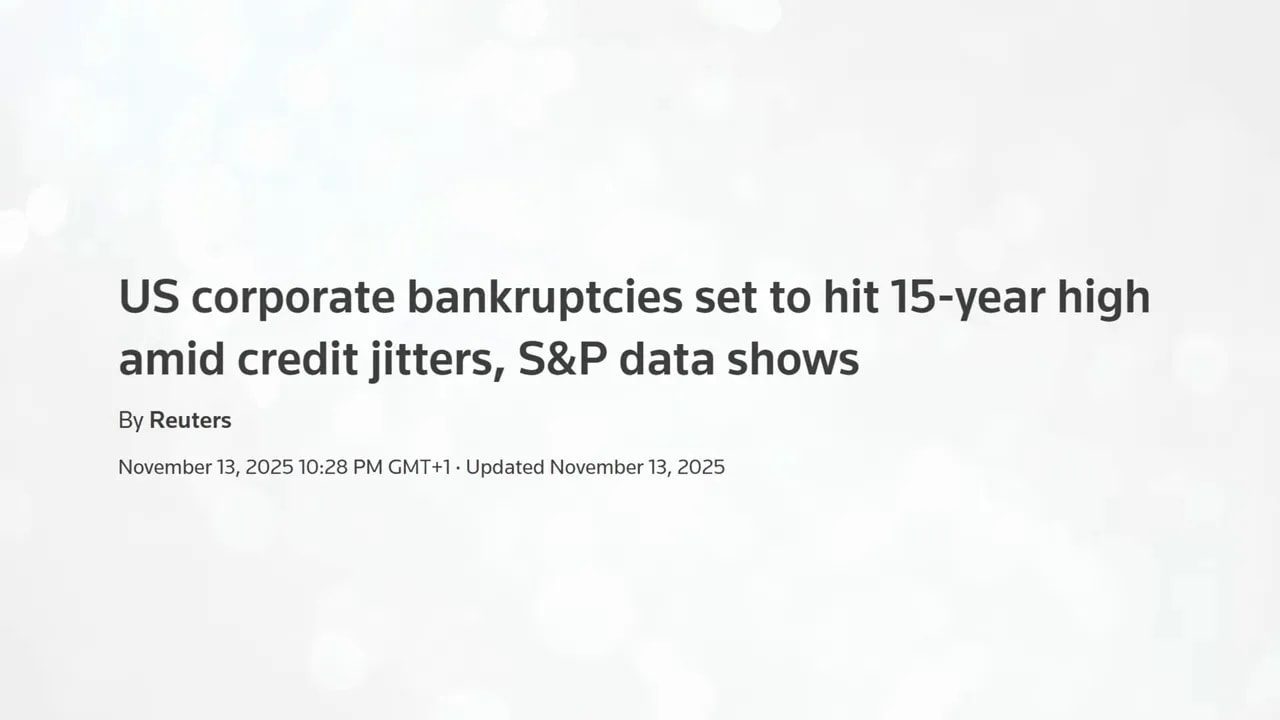
- Corporate bankruptcies are at multi-year highs.
- A record number of borrowers are missing auto loan payments.
- Commercial real estate continues to struggle.
- Regional bank stress surfaced last year and remains a risk factor.
- Within major stock indices, winners are concentrated in defensive sectors — consumer staples, healthcare, and utilities — the types of stocks that hold up during economic stress.
These signs suggest credit stress and demand weakness are building beneath the surface, even if headline indicators are calm for now.
What a deflationary bust would mean for Bitcoin
If we do enter a deflationary bust, expect a two-stage outcome for Bitcoin:
- Short-term pain: Bitcoin would likely fall materially. In deflationary episodes investors seek liquidity and deleveraging occurs. Highly leveraged crypto positions would face mass liquidations and price declines. Bitcoin behaves like a risk asset during these shocks.
- Policy response and recovery: Governments usually react to severe economic pain with interventions — liquidity injections, rate cuts, or direct support. When that relief arrives, risk assets revive and Bitcoin, as one of the purest risk-on instruments, often rallies strongly.
How to think about positioning
The contrarian thesis is not a call to panic but a reason to plan. Consider three practical steps:
- Assess leverage exposure — if you or your trading strategy relies on margin, plan for increased volatility and liquidations.
- Build optionality — hold some liquidity or stablecoins to take advantage of bottoms after a policy response.
- Watch leading indicators — credit spreads, commercial real estate headlines, consumer delinquencies, and the dollar trend will give faster clues than lagging GDP printouts.
Trading opportunities and tools
Volatility creates opportunity on many blockchains and across asset types. During dislocations you can find asymmetric setups: buy-the-dip opportunities, rebalance across spot and derivatives, or deploy strategies that profit from volatility spikes.
If you trade actively, reliable market signals matter. Crypto trading signals can help you spot entry and exit points faster, filter noise, and implement disciplined trade management across chains. Integrating a signals service into your toolkit can be especially helpful during fast-moving, high-leverage episodes when emotions and slippage are high.
Big-picture takeaway
Metals rallying can mean different things. If gold is rising because investors expect fiat debasement and inflation, that is broadly bullish for Bitcoin. If gold is rising because markets are scared of a deflationary bust, that is potentially catastrophic for risk assets in the short term — including Bitcoin.
The smart approach is not to pick a side and ignore warning signs. Monitor both the headline macro metrics and the alternate, on-the-ground indicators of credit stress. Prepare for short-term drawdowns while keeping capital reserved for the eventual recovery once policy responses reintroduce liquidity.
Recommended signals and monitoring checklist
Keep an eye on these items daily or weekly:
- DXY direction and persistence
- Credit spread moves (corporate and bank indexes)
- Liquidity indicators (repo rates, funding spreads)
- Real yields and growth expectations
- Consumer and corporate delinquency headlines
Pair that monitoring with a disciplined signals service to help translate noisy data into actionable trade ideas and risk management steps.
Conclusion
The metals rally is a red flag that deserves nuance. It could be bullish for Bitcoin if it reflects debasement fears. Or it could be a warning of a deflationary bust that crushes risk assets first and only makes Bitcoin a beneficiary later after policy intervention. Knowing both narratives and preparing for either outcome gives you the best chance to protect capital and exploit market dislocations.
FAQ
Can gold rally and Bitcoin rally together?
Yes. When the market fears fiat debasement and monetary stimulus, both gold and Bitcoin can rise together. The historical relationship often shows gold leading and Bitcoin catching up once the narrative shifts.
How would a deflationary bust hurt Bitcoin?
In a deflationary shock, demand and credit contract, leverage is unwound, and investors move to cash. Bitcoin behaves like a risk asset in that environment and typically falls sharply until liquidity returns via policy response.
What indicators should I watch to spot a pre-deflationary period?
Watch for a sustained dollar rally, widening credit spreads, tightening liquidity conditions, falling real rates, and broad weakness in risk assets. Also monitor corporate bankruptcies, consumer delinquencies, and commercial real estate stress as early warning signs.
Should I use crypto trading signals during this environment?
A quality signals service can help you identify trade setups, manage risk, and react quickly during volatile, leveraged moves. Signals are particularly useful when market structure shifts rapidly and disciplined execution matters.
Is this just fearmongering or a reasonable hedge?
This is a contrarian but reasonable scenario to consider. It is not certain, but risk management demands planning for low-probability, high-impact outcomes. Balancing defensive positioning with reserve capital for opportunities is pragmatic.