
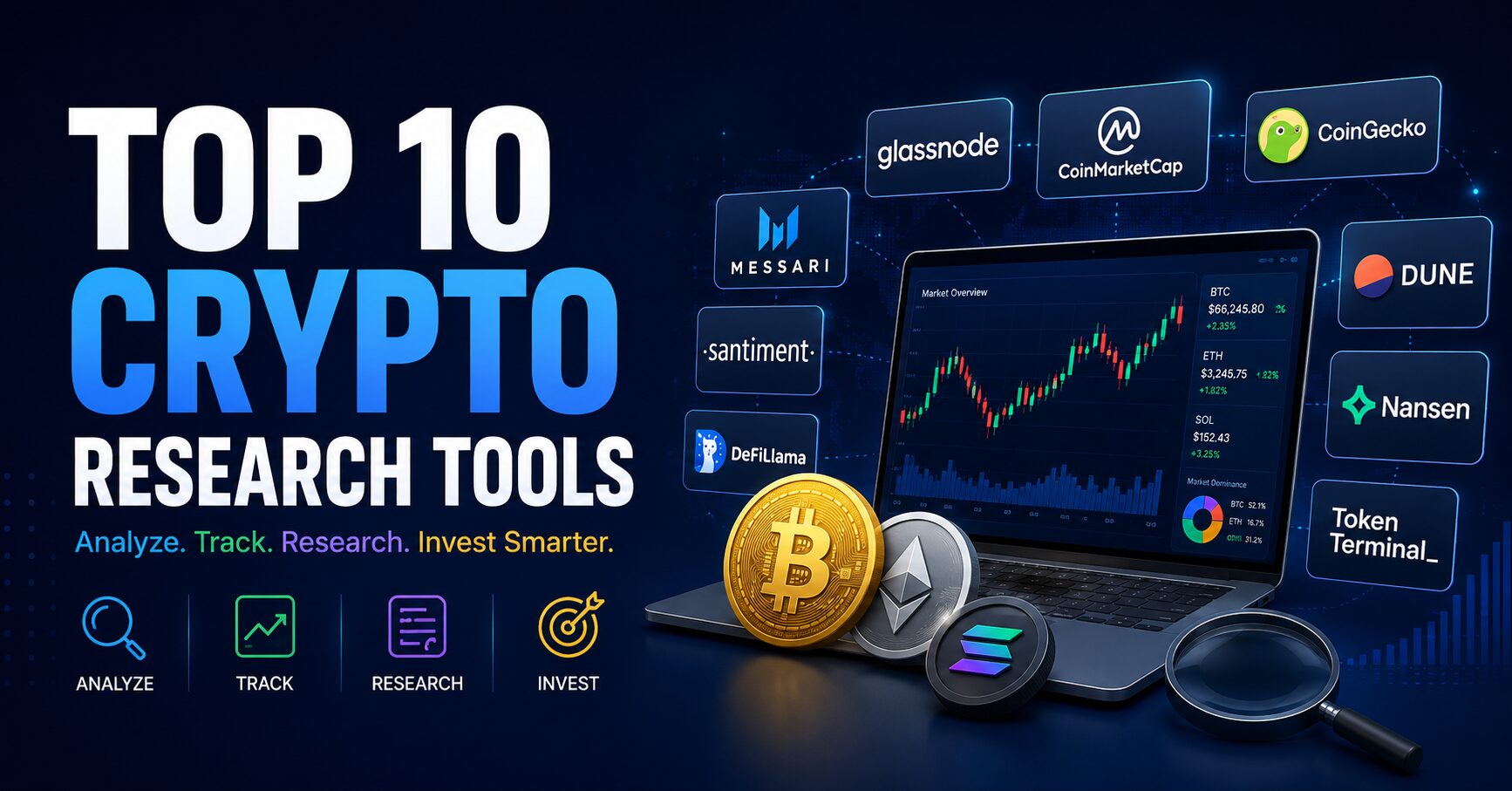
Crypto research does not have to be complicated. What matters is choosing the right tools for the job.
Some platforms are great for basic price tracking. Others are built for serious on-chain analysis, DeFi analytics, social sentiment, or project-level fundamentals. If you are trying to make better decisions in crypto, the quality of your research stack can make a huge difference.
This guide breaks down 10 of the best crypto research tools for investors and traders, plus one bonus platform that can help you spot momentum before it fully shows up on the chart.
The list covers a wide range of use cases, including:
- Price tracking
- On-chain data
- DeFi analytics
- Web3 and NFT discovery
- Technical analysis
- Crypto education for beginners
- Social sentiment and trend monitoring
Table of Contents
- What makes a good crypto research tool?
- 1. Messari for professional-grade crypto research
- 2. Coin Metrics for reliable on-chain and market data
- 3. DeFi Llama for DeFi analytics, TVL, and airdrop tracking
- 4. CoinMarketCap for beginner-friendly crypto price tracking
- 5. Binance Academy for learning the basics fast
- 6. Dune Analytics for custom on-chain dashboards without coding from scratch
- 7. TradingView for technical analysis and chart-based decision-making
- 8. Token Terminal for blockchain fundamentals and project-level metrics
- 9. DappRadar for discovering Web3 apps before they get crowded
- 10. DEX Screener for decentralized token tracking and liquidity checks
- Bonus: Santiment for crypto social sentiment and early trend detection
- How to combine these tools into a smarter research workflow
- A final note on research, signals, and execution
- FAQ
What makes a good crypto research tool?
The best platforms usually do one of three things really well:
- They make reliable data easy to access
- They help you understand what the data means
- They help you act faster when opportunities appear
That last point matters more than people think. Research is not just about collecting numbers. It is about turning raw information into conviction. If you are actively trading, that can also mean pairing your own analysis with curated market setups, which is why some traders use best crypto trading signals alongside charting and on-chain tools to save time and stay focused on higher-probability moves.
1. Messari for professional-grade crypto research
Messari is often described as the Bloomberg of crypto, and that comparison makes sense.
If you want professional-grade research, fundraising data, project information, and crypto industry news in one place, Messari is a strong starting point. It is especially useful for anyone who wants a more institutional-style research experience rather than jumping between random dashboards and social posts.
Why it stands out:
- Research reports on major crypto sectors and projects
- Fundraising and market intelligence data
- Industry news in a more structured format
- A feel that is closer to traditional financial research platforms
If you are going deep down the crypto rabbit hole and want data presented with a higher level of structure, Messari is one of the most useful platforms to keep bookmarked.
2. Coin Metrics for reliable on-chain and market data
Coin Metrics is built for people who like numbers, charts, and historical context.
It provides high-quality data around prices, trading volume, and network metrics. That makes it particularly useful for analysts, serious investors, and anyone trying to understand what is happening beneath the surface of market price action.
Its core strength is trust in the data. Historical crypto data can be messy, and that is exactly why a platform like Coin Metrics matters.
Coin Metrics is especially useful for:
- Tracking historical network activity
- Comparing price and volume trends
- Studying broader blockchain health metrics
- Building stronger market context before entering trades
For anyone doing deep analytics, this is the kind of tool that helps separate noise from signal.
3. DeFi Llama for DeFi analytics, TVL, and airdrop tracking
If your focus is DeFi, DeFi Llama belongs near the top of the list.
The platform is widely used for tracking total value locked, but it goes beyond that. It also covers airdrops, token usage, governance stats, and even parts of the NFT ecosystem.
In practical terms, DeFi Llama helps answer questions like:
- Which protocols are gaining or losing liquidity?
- Which chains are growing?
- Where is capital flowing in DeFi right now?
- Are there new airdrop opportunities worth monitoring?
That makes it one of the best free tools for understanding what is actually happening across decentralized finance.
If you are scanning multiple blockchains for breakout activity, pairing DeFi dashboards with timing tools can be especially powerful. Some traders complement that process by using crypto signals for trading as a second layer of confirmation, particularly when momentum starts building on specific ecosystems.
4. CoinMarketCap for beginner-friendly crypto price tracking
CoinMarketCap remains one of the most popular crypto data aggregators for a reason: it is simple, familiar, and easy to use.
You can search thousands of cryptocurrencies, check live prices, review market cap rankings, and explore categories like NFTs and Web3 tokens. For many people, this is the first research platform they ever use.
Its biggest advantage is accessibility. You do not need advanced skills to get value from it.
CoinMarketCap is ideal for:
- Quick price checks
- Exploring newly listed or trending tokens
- Comparing market caps and circulating supply
- Getting a broad overview of the crypto market
If you are just starting your crypto research journey, it is one of the easiest places to begin.
5. Binance Academy for learning the basics fast
Research is not only about data. Sometimes the most valuable tool is the one that helps you understand the language of crypto in the first place.
That is where Binance Academy fits in. It is designed for beginners, with explainers and educational articles that help people get up to speed on crypto concepts without feeling overwhelmed.
Useful topics often include:
- Blockchain basics
- Wallets and private keys
- DeFi and staking concepts
- NFTs and Web3 terminology
- Trading fundamentals
It is also helpful if you want a steady stream of educational content without digging through technical documentation.
For newer traders, education plus execution support is often the best combination. That is one reason many people compare free vs paid crypto signals after learning the basics, since the right service can help bridge the gap between theory and actual market decision-making.
6. Dune Analytics for custom on-chain dashboards without coding from scratch
Dune Analytics is one of the most flexible research tools in crypto.
It lets you fetch on-chain data from Web3 projects and build custom dashboards around DeFi, dApps, NFTs, and more. If you want to explore crypto data in a more tailored way, Dune is a great option.
The appeal here is customization. Instead of relying only on standard dashboards, you can drill into the specific metrics that matter to your strategy or thesis.
Dune is useful for:
- Exploring wallet and protocol activity
- Tracking ecosystem-specific trends
- Building dashboards that fit your own research process
- Reading on-chain data in a more accessible way
The metadata around this tool emphasizes an important point: you can start reading on-chain data without needing to write code yourself. That lowers the barrier significantly for people who want deeper crypto research but are not developers.
7. TradingView for technical analysis and chart-based decision-making
TradingView is still one of the biggest powerhouses for charting, and not just in crypto.
If technical analysis is part of your workflow, this tool is hard to ignore. It helps you analyze price charts across crypto and traditional assets, use indicators, annotate setups, and follow ideas from other traders.
Why so many traders rely on it:
- Advanced charting tools
- Large library of indicators
- User-generated ideas and analysis
- Coverage beyond crypto, including stocks, forex, and commodities
It is also one of the best platforms for building actual trading skill over time. You are not just looking at prices. You are learning how markets behave.
For anyone trying to sharpen entries and exits, TradingView can work well alongside broader market research tools. And if you are balancing your own technical analysis with curated trade ideas, using a best crypto trading signals service can add another layer of structure when markets move quickly.
For more context on charting workflows and features, TradingView’s official site at TradingView is also worth exploring directly.
8. Token Terminal for blockchain fundamentals and project-level metrics
Token Terminal brings a more traditional finance mindset into crypto analysis.
It focuses on raw blockchain metrics and decoded data for hundreds of projects, helping users evaluate protocols in a way that feels closer to equity research and fundamentals.
One especially practical feature is its integration with Google Sheets, which makes deeper analysis easier if you like working with your own models or comparison tables.
Token Terminal is well suited for:
- Comparing protocol-level performance
- Reviewing blockchain metrics in a cleaner format
- Conducting deeper project analysis
- Exporting data into spreadsheet workflows
For serious investors, it can be a useful bridge between crypto-native metrics and the kind of analysis often seen in traditional finance.
9. DappRadar for discovering Web3 apps before they get crowded
DappRadar is all about discovery.
It ranks decentralized applications across categories like DeFi, NFTs, and blockchain gaming, giving you a practical way to explore the Web3 ecosystem and identify projects that are getting traction.
This matters because great opportunities often show up first at the application layer. A chain may be growing, but the real signal can come from the specific apps attracting users and activity.
DappRadar helps with:
- Finding popular dApps across chains
- Exploring emerging NFT and game ecosystems
- Tracking app rankings and traction
- Spotting potential gems early
If your strategy includes identifying trends before they become mainstream, this is a tool worth checking regularly.
10. DEX Screener for decentralized token tracking and liquidity checks
DEX Screener is one of the most useful tools for navigating the decentralized side of crypto.
It is designed for tracking token prices and trade history on decentralized exchanges. That makes it especially valuable when you are researching newer assets that may not yet be widely covered on larger centralized data platforms.
What makes it so useful:
- Real-time token price tracking
- Access to trade history
- Visibility into liquidity conditions
- Strong utility for exploring emerging Web3 tokens
When you are checking a token on-chain, liquidity matters. A chart can look exciting, but poor liquidity changes the risk completely. DEX Screener helps bring that context into the decision.
For active traders looking at fast-moving decentralized markets, tools like DEX Screener can complement charting and on-chain analytics extremely well.
Bonus: Santiment for crypto social sentiment and early trend detection
The bonus tool is Santiment, and it deserves the extra spotlight.
Santiment focuses on social sentiment analysis in crypto. It tracks social media discussion, on-chain data, and development activity to help gauge the mood around specific projects and tokens.
That is valuable because markets are not driven by fundamentals alone. They are also driven by attention, narrative, and crowd behavior.
Santiment can help you answer questions like:
- Is a token suddenly getting a lot of social traction?
- Is interest fading even while price still looks stable?
- Is development activity supporting the hype?
- Could a market narrative be building before a larger move?
This makes Santiment a strong addition to any research stack, especially if you want to stay ahead of crowd psychology rather than react to it late.
Sentiment tools are not crystal balls, but they can be powerful when combined with price structure, liquidity data, and on-chain signals. That is often where stronger trade ideas come from: multiple forms of confirmation lining up at once.
For broader context on market sentiment in digital assets, resources from firms like Chainalysis can also be useful, especially when you want industry-level data alongside token-specific research.
How to combine these tools into a smarter research workflow
You do not need to use all 10 tools every day.
A better approach is to build a simple workflow based on what you are trying to do.
For beginners
- Use CoinMarketCap to track prices and market rankings
- Use Binance Academy to learn core concepts
- Use TradingView to start understanding charts
For DeFi-focused research
- Use DeFi Llama for TVL, airdrops, and protocol stats
- Use Dune Analytics for custom on-chain dashboards
- Use DEX Screener to track decentralized token action
For fundamental and institutional-style analysis
- Use Messari for research and fundraising data
- Use Coin Metrics for trusted historical metrics
- Use Token Terminal for deeper protocol analysis
For trend discovery and momentum monitoring
- Use DappRadar to spot active apps and ecosystems
- Use Santiment to monitor sentiment and social buzz
- Use TradingView to validate price action
The point is not to overload yourself. The point is to make your research sharper, faster, and more consistent.
A final note on research, signals, and execution
Even the best crypto research tools are only part of the process. They help you understand the market, but they do not remove risk.
That is why many traders combine independent research with structured execution tools, alerts, or professional signal services. Used properly, signals should not replace research. They should support it. If you want a deeper look at how that balance works in practice, a guide on the best crypto trading signals can help clarify what to look for and how to avoid low-quality providers.
And one more thing that often gets missed: every crypto trade can create a taxable event. If you are using multiple exchanges, wallets, and decentralized platforms, keeping records organized matters just as much as finding the next opportunity.
FAQ
What is the best crypto research tool for beginners?
For beginners, CoinMarketCap and Binance Academy are two of the easiest starting points. CoinMarketCap helps with price tracking and market discovery, while Binance Academy explains crypto concepts in a straightforward way.
Which tool is best for DeFi analytics?
DeFi Llama is one of the best free tools for DeFi analytics. It is especially useful for tracking total value locked, token usage, governance stats, and airdrop-related information across multiple chains.
What is the best tool for on-chain crypto data?
Coin Metrics and Dune Analytics are both strong options. Coin Metrics is great for reliable historical data and network metrics, while Dune Analytics is ideal for custom dashboards and more flexible on-chain exploration.
Is TradingView still worth using for crypto?
Yes. TradingView remains one of the most widely used charting platforms for crypto technical analysis. Its indicators, chart tools, and active user community make it valuable for both beginners and experienced traders.
Which crypto tool helps track decentralized exchange tokens?
DEX Screener is one of the best tools for tracking decentralized exchange tokens. It helps with price tracking, trade history, and liquidity analysis for assets trading in the decentralized ecosystem.
Can sentiment data really help with crypto research?
It can help when used alongside other data. Santiment tracks social chatter, on-chain activity, and development signals, which can help identify shifts in attention and momentum before they become obvious in price action alone.
Do I need all of these crypto tools?
No. Most people only need a few tools that match their goals. A beginner may only need CoinMarketCap, Binance Academy, and TradingView, while an advanced DeFi trader may lean more on DeFi Llama, Dune Analytics, and DEX Screener.