

Most people in crypto get stuck on the same question: Is Bitcoin in a bull market or a bear market?
That question sounds important, but for traders it can actually become a distraction.
The better question is much simpler: Did you make money?
Markets go up. Markets go down. And sometimes they do absolutely nothing for weeks or months. If your entire strategy depends on being perfectly right about the big-picture direction, you are putting yourself at a huge disadvantage. A lot of traders leave money on the table because they only want to participate in one kind of market.
If you want to make more money trading Bitcoin, you need a process that works inside a trend, inside a range, and even inside those frustrating sideways periods that make everyone else emotional.
Table of Contents
- Trading Bitcoin is not about prediction, it is about execution
- Why range-bound markets can still be highly profitable
- The approach: long, short, hedge, and protect capital
- What good Bitcoin technical analysis actually looks like
- Why stop losses and partial profit-taking matter so much
- Real-time trading education beats hindsight analysis
- The value of updates inside an active trading group
- How hedging can help when the market has both bullish and bearish paths
- A successful short is still a good trade in a bullish market
- What a clean trade recap teaches about planning
- The bigger lesson: make money in the market you have, not the market you want
- What to look for if you are learning Bitcoin trading
- Final thought
- FAQ
Trading Bitcoin is not about prediction, it is about execution
One of the biggest mindset shifts in crypto trading is this: you do not need to predict every macro move to be profitable.
You need to read the chart in front of you, identify the structure, manage your risk, and take the trade that is there.
That means:
-
going long when the setup supports a long,
-
going short when the setup supports a short,
-
locking in profits as the market moves,
-
protecting your position in case price reverses,
-
and never confusing hope with strategy.
This is the real edge. Not being loud. Not making dramatic price predictions. Not pretending every move is obvious in hindsight.
Just disciplined trading.
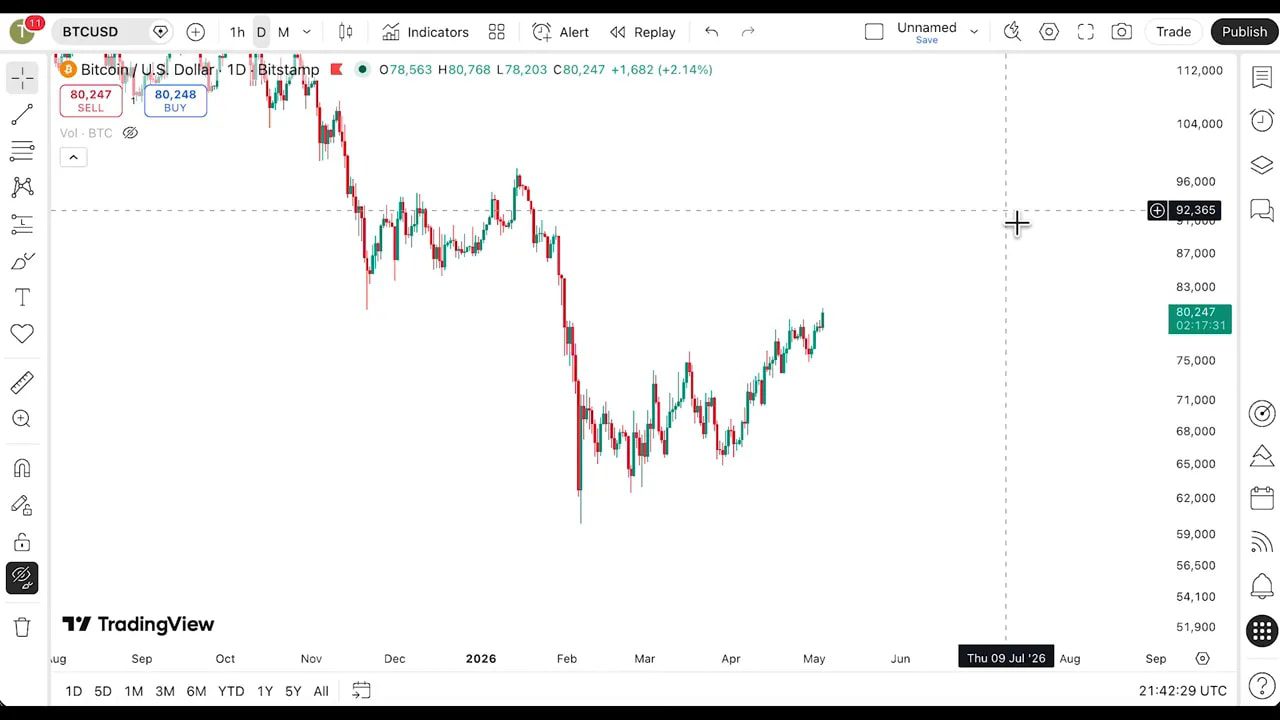
Why range-bound markets can still be highly profitable
Too many traders treat a sideways market like dead time.
That is a mistake.
A clean range can offer multiple opportunities if you know how to trade it. Long near support. Short near resistance. Take profits into strength or weakness. Reset. Wait for the next setup. Repeat.
That is exactly the kind of trading approach highlighted here. The point was not simply calling the ultimate bottom. The point was making money throughout the range.
There was a long taken near one side of the structure, profits taken near the highs, then a short from the highs, profits taken as price moved down, then another short, then another long. Some positions worked beautifully. Some were adjusted. One was eventually stopped out after partial profit. That is normal trading.
The important part is the framework:
-
Trade the structure, not your bias.
-
Take what the market gives you.
-
Accept that both longs and shorts can make sense in the same broader range.
If you only know how to trade when Bitcoin is ripping upward, your strategy is incomplete. And if you only know how to call for collapse, that is incomplete too.
Strong traders adapt.
The approach: long, short, hedge, and protect capital
A practical example shared in the discussion was a long entry around $64,100, give or take. But the more important detail was not the entry itself. It was what happened next.
Fifty percent of the profits were already taken.
That matters because protecting a trade is part of the trade. There was still recognition that the low might get swept again. Instead of staying greedy and leaving the whole position exposed, profits were taken and the position was protected.
This is a mature trading mindset.
Many traders do the opposite:
-
they enter late,
-
they use too much leverage,
-
they refuse to take profits,
-
then they get stopped out with nothing.
That is not trading. That is emotional gambling.
A stronger framework looks more like this:
-
Enter where the setup makes sense.
-
Define invalidation before entering.
-
Take partial profits at logical levels.
-
Move your stop to protect gains when appropriate.
-
Allow the remainder of the position to continue if momentum holds.
If you use trade alerts or a crypto signal service as part of your process, this is exactly the kind of discipline you want to see: clear entry logic, invalidation levels, profit targets, and active risk management. A signal without a plan is noise.
If you want a better framework for interpreting setups and managing trades, this guide on how to use your crypto signals for maximum profit is a useful companion.
What good Bitcoin technical analysis actually looks like
There is a reason structured technical analysis stands out in crypto. Most of the space is full of hype, recycled talking points, and unrealistic promises.
Good analysis is different.
It is chart-based. It is specific. It acknowledges risk. It gives a reason for the setup. It explains where the trade is wrong. And it teaches execution, not just direction.
That is why the discussion highlighted Mind Pillar Markets, a two-man trading team made up of Andy and DeWald. The appeal was straightforward: daily technical breakdowns, educational market analysis, chart-based insights, and a no-hype approach to Bitcoin and the broader crypto space.
What stood out most was not a flashy promise of “easy money.” It was the emphasis on understanding:
-
market behavior,
-
risk,
-
trade execution,
-
and how to handle both bullish and bearish scenarios.
If you are serious about developing as a trader, that is the kind of content worth paying attention to.
For traders who want deeper context on market structure and support zones during sharp selloffs, this breakdown of Bitcoin support levels and market insights adds useful perspective.
Why stop losses and partial profit-taking matter so much
One of the best educational points in the entire discussion was the focus on how to set up a stop loss and how to lock in profit.
Those two things are not glamorous, but they are the backbone of staying alive in crypto trading.
A sample setup was explained in simple terms:
-
identify where the trade idea becomes invalid,
-
use that level as a stop,
-
target a major resistance zone to the upside,
-
and make sure the risk-to-reward ratio justifies the trade.
In the example, the risk-to-reward was about 2.4, which met the minimum requirement.
That is a key lesson. Not every chart pattern is worth trading. Even if you think the direction is right, the trade may still be poor if the risk-to-reward is weak.
A professional setup asks:
-
Where do I enter?
-
Where am I wrong?
-
Where do I take profit?
-
Does the potential upside justify the downside?
If you cannot answer those four questions, the trade probably is not ready.
For a more formal overview of risk calculations, the risk-reward ratio explained by Investopedia is a solid external reference.
Real-time trading education beats hindsight analysis
One reason traders get trapped is because they consume too much hindsight content.
Anyone can post a perfect chart after the move is over.
Real educational value shows up when someone explains the setup before it fully plays out, takes the trade in real time, and then manages it transparently.
That was another major strength emphasized here. There was an example of opening a small position live with 20x leverage, while also being honest about not loving a slightly late entry and using less capital because of that. That kind of nuance matters.
It shows restraint.
It shows awareness of execution quality.
And it reinforces a basic truth: even when a setup is valid, position sizing still matters.
The market does not reward ego. It rewards discipline.
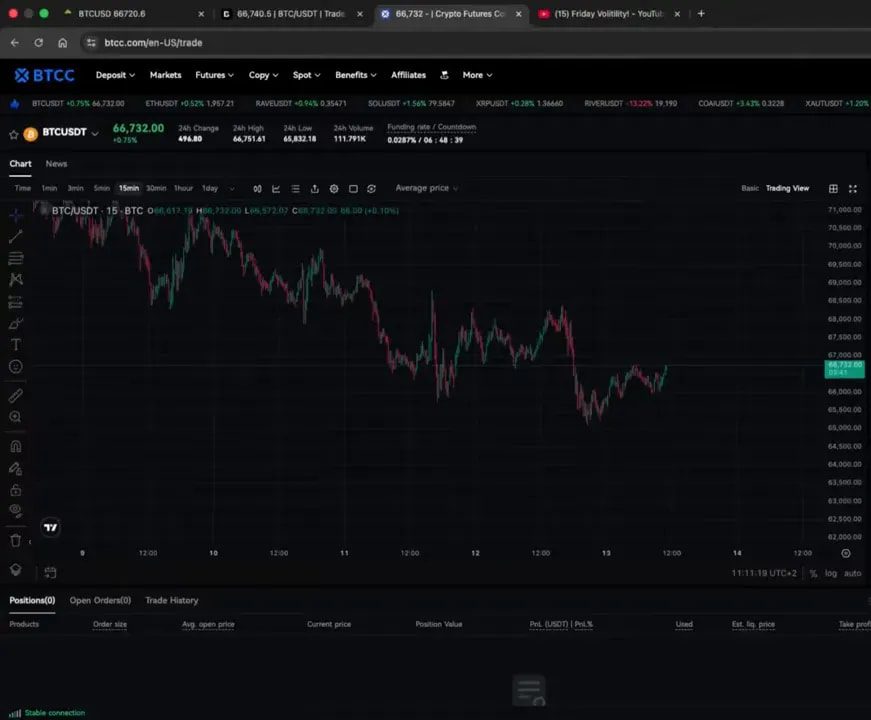
The value of updates inside an active trading group
Another part of the strategy discussed was the benefit of a trading group where updates continue after the initial trade idea is shared.
This is where many traders fall short on their own. Entering a position is only one small piece of the process. The hard part is managing it as conditions change.
Examples shared from the group included:
-
not planning to add to a position,
-
taking profit after price tapped the 0.382 Fibonacci level,
-
identifying the next profit-taking area near the 0.5 Fibonacci around $75,200,
-
spotting a bearish setup for traders looking to short,
-
using cumulative data and bearish CVD divergence as confirmation,
-
and updating the group again after taking more profit from a short.
This kind of communication is useful because it reflects how trading really works. The plan evolves. The market moves. Targets get hit. Conditions improve or deteriorate. Sometimes you press. Sometimes you reduce.
If you are comparing services, this is also what separates a thoughtful crypto signal setup from generic callouts thrown into a chat. Strong signals include context, invalidation, management, and follow-up.
If you are weighing different options, this article on free vs paid crypto signals can help clarify what to look for.
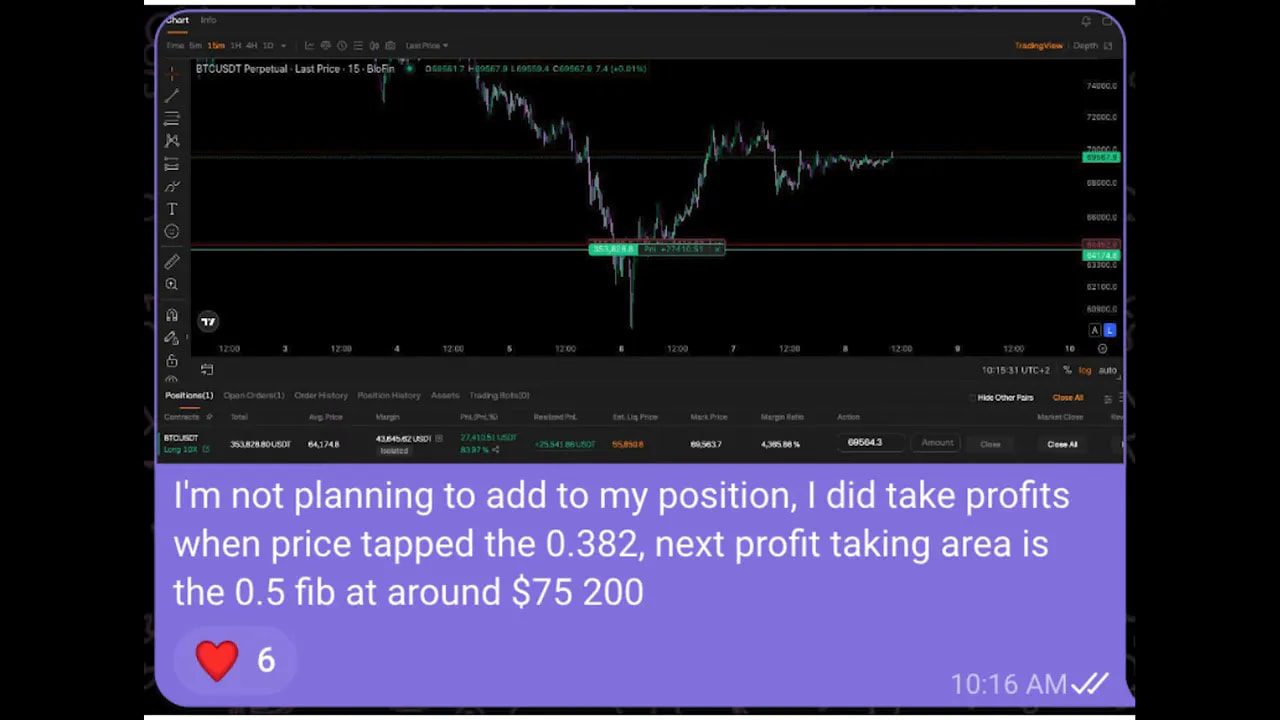
How hedging can help when the market has both bullish and bearish paths
One particularly practical idea discussed was using a short as a hedge against an existing long.
This is not something every trader needs to do, but it is a useful concept to understand.
The logic was clear: while holding a long, there was still a believable bearish case that Bitcoin could drop all the way to $63,000. If a clean short entry appeared, taking that short would help offset the risk of the long being stopped out.
That is smart trading.
Not because it is fancy, but because it acknowledges uncertainty.
You do not always need to be all-in on one directional view. Sometimes the best move is to carry a hedge while the market decides.
That kind of flexibility is especially useful in crypto, where conditions can flip fast and volatility can expand without much warning.
If you want a neutral explanation of hedging mechanics, the CME Group overview of hedging and risk management offers solid background.
The key lesson here is not “always hedge.” The lesson is this:
build a strategy that respects multiple possible outcomes.
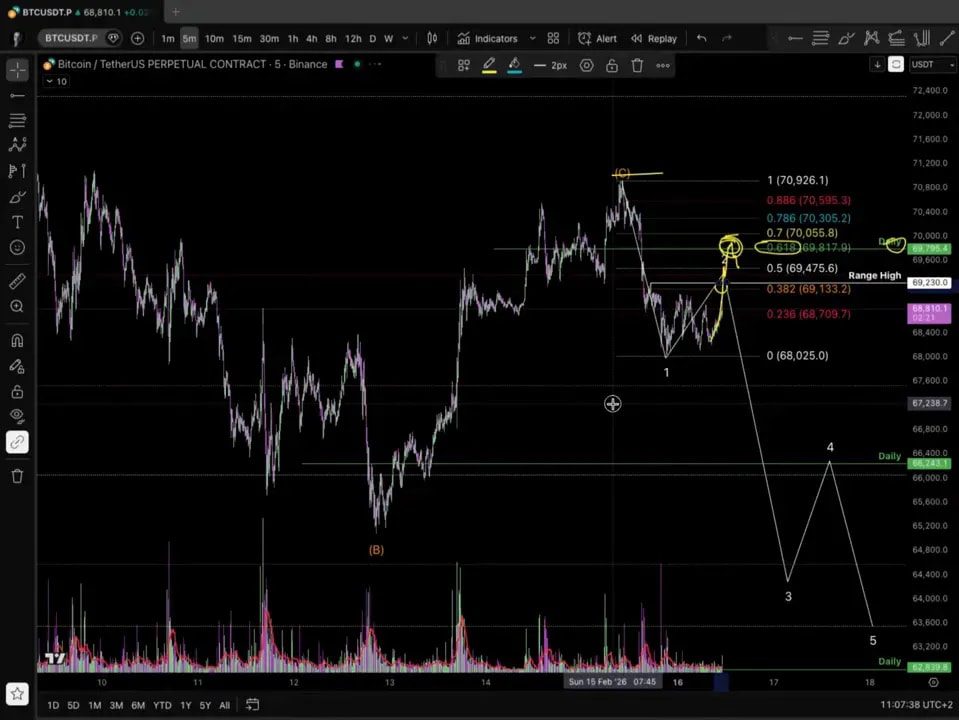
A successful short is still a good trade in a bullish market
This is where a lot of people struggle emotionally.
They think that if they are bullish on Bitcoin long term, they should never short it. Or if they are bearish short term, they should never long it.
That is not how active trading works.
A successful short inside a bullish consolidation can still be a great trade. A successful long inside a broader correction can also be a great trade. Timeframe matters. Structure matters. Context matters.
One example highlighted involved a short trade that was clearly explained ahead of time and then updated afterward as it played out. Members of the group were able to follow the logic, understand the setup, and benefit as the move developed.
The larger takeaway is simple:
-
You are not marrying a bias.
-
You are responding to price action.
-
You can be bullish on Bitcoin and still short a local move.
-
You can be cautious and still take a quality long when the setup appears.
What a clean trade recap teaches about planning
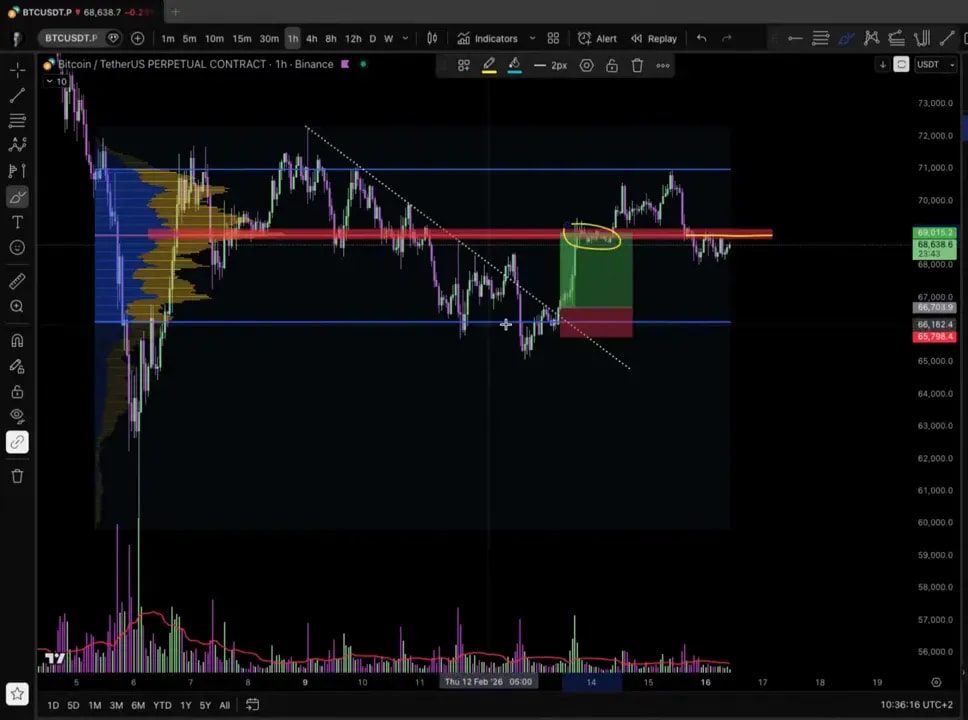
A later trade recap focused on a setup that had played out “to perfection.” The explanation referenced a one-two, one-two structure and a key low that should not be reclaimed if the bullish pattern remained valid.
That low held.
Price accelerated upward.
The trade worked.
What makes this valuable is not just that it was profitable. It is that the trade had a clear thesis beforehand:
-
a specific pattern was identified,
-
a key invalidation level was defined,
-
the expected reaction was stated in advance,
-
and then the market either respected it or would have invalidated it.
That is how a trader should think.
Not “I feel bullish.”
Not “someone on X said moon.”
But rather: if this level holds, I expect this outcome. If not, I am wrong and I manage the risk.
The bigger lesson: make money in the market you have, not the market you want
The core message running through everything here is one of the best lessons in crypto trading:
Play the charts as they are, not as you wish they would be.
That means:
-
stop waiting for the perfect macro narrative,
-
stop arguing endlessly about bull versus bear,
-
stop treating sideways markets as untradeable,
-
and start focusing on structure, entries, invalidation, and profit-taking.
There is nothing wrong with having a long-term thesis. In fact, Altcoin Daily makes it clear in the broader channel description that the long-term game is accumulating as much Bitcoin as possible, with alts used more selectively to accumulate more Bitcoin and Ethereum.
But trading is different from investing.
Investing asks, “What do I want to own for the next cycle?”
Trading asks, “What is the market offering me right now?”
Those are not the same thing.
What to look for if you are learning Bitcoin trading
If you are trying to improve as a Bitcoin trader, these are the traits worth seeking out in educators, trading communities, or any crypto signal service you choose to use:
-
Clear chart-based reasoning instead of vague hype
-
Defined stop losses instead of “just hold”
-
Profit-taking plans instead of blind greed
-
Real-time updates instead of hindsight posting
-
Comfort with both longs and shorts when structure supports them
-
Risk management as a central skill, not an afterthought
If the analysis you follow does not teach you how to manage risk, it is incomplete.
If the trade ideas you follow never mention invalidation, they are incomplete.
If everything is framed as certainty, it is probably not serious trading education.
Final thought
The traders who last in crypto are usually not the loudest. They are the ones who know how to operate in every kind of market.
They do not need Bitcoin to go straight up every day.
They do not panic when the market ranges.
They do not act like every setup is all-or-nothing.
They trade the structure. They protect capital. They lock in profit. They stay flexible.
And most importantly, they keep asking the only question that really matters:
Did you make money?
FAQ
Is it necessary to know whether Bitcoin is in a bull or bear market to trade profitably?
No. That can help with context, but profitable trading does not require perfect macro calls. The more important skill is reading market structure, managing risk, and taking high-quality setups whether price is moving up, down, or sideways.
What does “trade the structure” mean?
It means trading what the chart is actually doing rather than what you want it to do. In practice, that can mean longing support, shorting resistance, reacting to confirmation, and respecting invalidation levels instead of clinging to a bias.
Why is taking partial profit so important in Bitcoin trading?
Partial profit-taking helps reduce risk and protect gains. Crypto is volatile, and a winning trade can reverse quickly. Locking in some profit allows a trader to stay in the move while reducing the emotional and financial pressure of a full-position reversal.
Can you short Bitcoin and still be bullish long term?
Yes. Long-term investing and short-term trading are different. A trader can be bullish on Bitcoin over the long run and still short a local move if the short-term chart setup supports it.
What should a quality crypto signal include?
A quality crypto signal should include the trade idea, entry zone, stop loss or invalidation level, profit targets, and ideally follow-up updates as conditions change. Without risk management and context, a signal is not very useful.
What is a hedge trade in crypto?
A hedge trade is a position taken to offset risk in another position. For example, if a trader is long Bitcoin but sees a valid bearish setup, opening a short can help reduce losses if the market drops and the long gets stopped out.
What is the most important skill for making more money trading Bitcoin?
Risk management. Good entries matter, but long-term consistency comes from proper position sizing, using stop losses, taking profits, and staying flexible as the market changes.